
A homeowner stops you on the driveway and asks the question every roofer hears: “So this is a lifetime warranty, right?” You say yes, because the shingle box says lifetime and because a yes closes the deal. Three years later that same homeowner calls about a leak over the kitchen, pulls out the paperwork, and finds out the “lifetime warranty” covers a prorated box of shingles and not one hour of labor to redo the valley your crew nailed wrong. Now you are the problem, the review is already typed, and the manufacturer is pointing back at you.
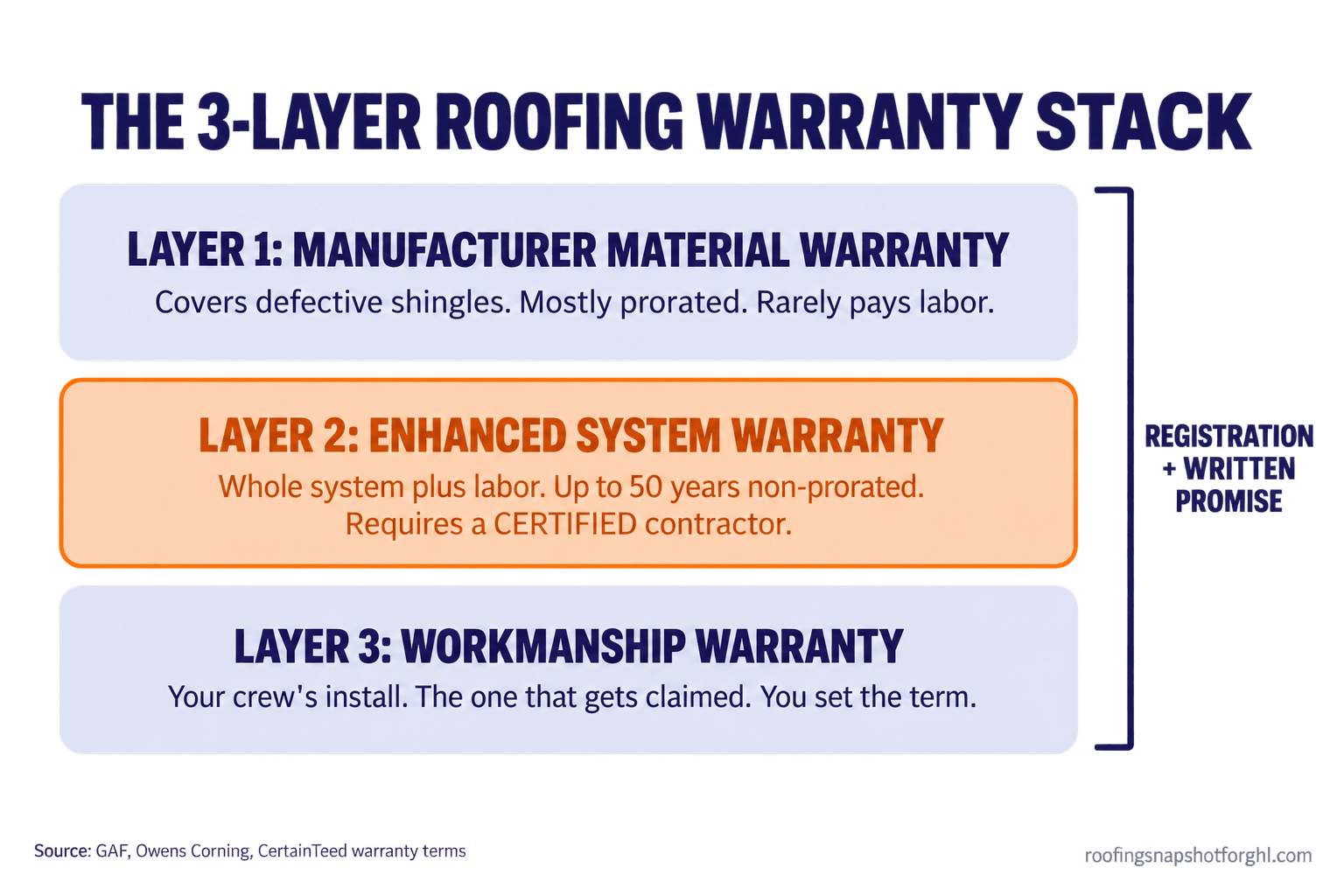
Here is the short answer. A roof carries up to three separate warranties, and most roofers blur them into one word on the porch. The manufacturer warranty covers defective shingles, almost never the labor. Your workmanship warranty covers your crew’s install, and it is the one that actually gets claimed. The enhanced manufacturer system warranty is the only thing that puts real labor coverage and a long non-prorated window behind the roof, and you only get to offer it if you are a certified contractor who registers the job. Get those three straight, promise only what is written down, and warranty stops being the thing that bites you two years after the check clears.
Key Takeaways
- There are three warranties, not one. The manufacturer material warranty, your workmanship warranty, and the enhanced manufacturer system warranty each cover different things. A “lifetime” shingle warranty is mostly prorated material, not labor (Owens Corning).
- Installation is what fails, not the shingle. Roof problems are “overwhelmingly workmanship-related” and often do not surface until around year six, the national average per the NRCA (Pro Remodeler). That is after a typical one-to-five-year workmanship warranty has run out.
- The enhanced warranty is a contractor credential, not a product. Owens Corning Platinum, GAF Golden Pledge, and CertainTeed 5-Star all require a certified installer and give up to 25 years of workmanship coverage and a 50-year non-prorated material window (Owens Corning; CertainTeed).
- Unregistered means uncovered. The enhanced warranty does not exist until you submit the registration. Skip it and the homeowner has the base warranty you could have given for free.
- Only promise what is in writing. Once you put a warranty in writing you must honor it and label it accurately (FTC). A vague “lifetime” promise on the porch is how a sale turns into a complaint.
Table of contents
- Why a sloppy warranty promise costs you money
- The three-layer warranty stack
- Layer 1: The manufacturer material warranty
- Layer 2: The enhanced manufacturer system warranty
- Layer 3: Your workmanship warranty
- The fine print that voids all three
- Registration and transferability
- The three enhanced warranties side by side
- Steal this: the warranty packet and registration SOP
- Run it for a solo, a mid-size, and a large shop
- What you can legally promise about a warranty
- Objections
- FAQ
Why a sloppy warranty promise costs you money
Warranty feels like paperwork until it is a leak over somebody’s kitchen. Then it is the fastest way to lose a review, a referral, and a weekend. The reason it hurts is a timing problem: the thing that actually fails is almost never the shingle.
Patrick Morin, a roofing CEO quoted in Pro Remodeler, put it plainly: “The overwhelming majority of the issues are workmanship-related,” and citing the National Roofing Contractors Association, he noted installation problems often do not appear until around the sixth year, the national average (Pro Remodeler). The defect shows up in year six. A typical contractor workmanship warranty runs one to five years. So the exact failure most likely to happen lands the year after your coverage quietly expired, and the homeowner is holding a “lifetime warranty” that pays for a prorated bundle of shingles and none of the labor.
Put a dollar figure on it. An average roof replacement runs around $9,500, from roughly $5,900 to past $13,000 on bigger homes (Angi). A workmanship callback is a tear-and-redo with a crew, a dumpster, and a homeowner who already does not trust you. The NRCA, again via Morin, reports “70% of all roofing contractors are out of business in 2 years” (Pro Remodeler), so a homeowner who knows that math knows a one-year promise from a two-year-old company is worth nothing. The warranty you can prove is a closing tool. The one you wave at on the porch is a liability you have not been billed for yet.
The three-layer warranty stack
Stop thinking “the warranty” and start thinking in three layers, because that is how the money and the liability split up.
Layer 1, the manufacturer material warranty. It comes in the shingle box whether you do anything or not. It covers manufacturing defects in the shingle. It is “limited lifetime” for the original homeowner, and after a short non-prorated window it prorates down to pennies. It almost never pays for labor.
Layer 2, the enhanced manufacturer system warranty. The upgrade: GAF’s System Plus, Silver Pledge and Golden Pledge; Owens Corning’s System Protection, Preferred and Platinum; CertainTeed’s SureStart PLUS tiers. It covers the whole system of components, extends the non-prorated window, and on the top tiers adds real labor and workmanship coverage. You can only offer it if the manufacturer has certified your company, and it only exists if you register the job.
Layer 3, your workmanship warranty. Your company’s own promise to fix install mistakes. It is the one that gets claimed, because installation is what fails. Its length is whatever you decide, and that decision is a real business lever, not a throwaway line.
Storm work makes all of this sharper. The US logged 5,432 hail events in 2025, up from 5,373 in 2024, and State Farm alone paid out over $5.6 billion in hail claims that year (Insurance Information Institute). Every one is a new roof with a warranty promise attached and a homeowner who will test it.
Layer 1: The manufacturer material warranty
This is the one on the box, and the one roofers over-sell. The standard warranty is, in Owens Corning’s own words, a “basic limited lifetime warranty, which is the industry standard,” and coverage is “generally for factory defects only, not installation errors” (Owens Corning). “Limited lifetime” sounds like forever. It means that as long as the original owner holds the home, the manufacturer covers a genuine defect in the shingle, with full material replacement for a short period, then a prorated amount after.
Owens Corning’s base Standard Product warranty carries a non-prorated “TruPROtection” period of just the first 10 years (Owens Corning). CertainTeed’s base SureStart covers 100% of material and labor for only the first 3, 5, or 10 years depending on the shingle line, then steps down (CertainTeed). After that window the homeowner gets a fraction of material cost and, under most base warranties, pays their own labor.
How it breaks, and the fix. It breaks on the porch, when “the shingle has a lifetime warranty” becomes, in the homeowner’s ears, “my whole roof is covered for life.” When a nail pops a seal or a valley leaks in year four, that is installation, which the material warranty does not touch. Never sell Layer 1 as the headline. Describe it accurately as defect coverage on the product, then pivot to the two layers that cover what actually goes wrong: your workmanship and, if you offer it, the enhanced system warranty.
Layer 2: The enhanced manufacturer system warranty
This is where the real coverage lives, and the layer most small shops leave on the table. The big three all sell an upgraded warranty covering the entire system, the shingles plus underlayment, starter, ridge cap and ventilation, far past the base.
The catch is that you cannot offer it unless the manufacturer has certified your company. Owens Corning’s System Protection, Preferred and Platinum warranties all “must be installed by an Owens Corning Roofing Platinum or Preferred Contractor,” and the top Platinum tier requires a Platinum Contractor specifically (Owens Corning). GAF’s Golden Pledge can only be offered by a Master Elite contractor (GAF). CertainTeed reserves its SureStart PLUS 3-Star, 4-Star and 5-Star warranties for ShingleMaster and SELECT ShingleMaster companies (CertainTeed).
What you get for that credential is substantial. Owens Corning’s enhanced tiers push the non-prorated window from 10 years to the first 50 years, and Platinum adds limited lifetime workmanship coverage, reduced after 25 years (Owens Corning). CertainTeed’s 5-Star gives a 50-year non-prorated material warranty plus 25 years of workmanship CertainTeed itself stands behind (CertainTeed). GAF’s Golden Pledge extends non-prorated coverage, covers tear-off and disposal, and backs the contractor’s workmanship for 25 years (GAF).
How it breaks, and the fix. Two ways. The shop never gets certified, so it only offers the base warranty and competes on price against companies selling a 50-year, labor-backed roof. Or a certified shop sells the enhanced warranty, collects for it, then never files the registration, so the coverage does not exist. Fix the first by earning at least one certification and making the enhanced warranty your lead offer. Fix the second with a hard, tracked registration step on every eligible job, below.
Non-prorated material coverage window in years, by Owens Corning warranty tier. The jump from 10 to 50 years is what contractor certification unlocks. Source: Owens Corning roofing warranty terms.
Layer 3: Your workmanship warranty
This is your promise, in your name, that if your crew installed something wrong, you come back and fix it for free. It is the layer that gets claimed, because installation is what fails. And it is where small roofers hurt themselves most, by offering the shortest possible term out of fear.
The industry norm is thin. Many contractors guarantee their work for only one or two years, most fall in a one-to-five-year range, while the manufacturer product warranty runs 20 to 50 years (Owens Corning; Pro Remodeler). Line that up against the year-six failure average and the trap is obvious: the standard workmanship warranty expires a year or more before the defect it should cover even appears.
How it breaks, and the fix. A leak shows up in year three or four, past your two-year promise, and you are stuck choosing between eating a tear-and-redo you are not on the hook for or saying no to a homeowner who will torch you online either way. Stop treating the term as a cost and start treating it as a close. Offer a longer standalone workmanship warranty, five or ten years, priced into the job, and track every covered roof so you know your real callback rate. If you carry a certification, lean on the enhanced warranty’s 25-year workmanship coverage, because then the manufacturer co-signs your install. A roof that fails on your workmanship is the same failure that quietly feeds your bad reviews and lost referrals. Covering it well is cheaper than earning it back.
Workmanship coverage in years: a typical standalone contractor warranty versus the top certified manufacturer tiers. Sources: Pro Remodeler, Owens Corning, CertainTeed, GAF.
The fine print that voids all three
Every one of these warranties has a list of ways it evaporates, and the homeowner finds the list the day they file a claim. You need it cold, because most voiding reasons are install decisions your crew makes.
The common ones: the wrong nailing pattern (manufacturers tie wind coverage to a specific number and placement of nails, often four-nail versus six-nail), inadequate attic ventilation, mixing non-matching accessories instead of using one manufacturer’s full system, installing over an existing layer when the enhanced warranty requires a tear-off, and incorrect flashing or valley details. Owens Corning’s own comparison notes that wind ratings depend on the nailing pattern used (Owens Corning). Install with four nails when the rating required six, and the wind claim is denied even though the roof is young.
How it breaks, and the fix. It breaks when the crew installs to habit instead of to the specific manufacturer’s published instructions for the specific warranty you sold. Standardize the install to the spec the warranty demands, document it with photos of the nailing, ventilation and flashing on every job, and keep that file on the customer record. When a claim comes, you want proof you installed to spec, not a fight you lose for lack of evidence. This is the same discipline that keeps a job moving through production without stalling: the details live in a system, not a crew lead’s memory.
Registration and transferability
The enhanced manufacturer warranty is not automatic. It does not exist until you submit the registration to the manufacturer, usually within a set window after install, with the product details and the homeowner’s information. Skip it, and the homeowner who paid for a 50-year Platinum system has, in reality, the base warranty you could have handed them for nothing.
Transferability is the half most roofers never mention. Many enhanced warranties can transfer to the next homeowner, often once, within a window after the sale. That transfer is a genuine selling point, because it raises resale value, but only if the original warranty was registered and the transfer paperwork gets filed. An unregistered warranty transfers nothing.
How it breaks, and the fix. Registration is a five-minute office task with no deadline anyone feels, so during a busy storm season it slides, and by the time anyone notices, the window closed. Make registration a required, dated step in your pipeline, triggered automatically when the job is marked complete, assigned to a specific person, and not closed until the confirmation number is attached to the record. The same system should fire the homeowner a copy of the registered warranty and a short note explaining what it covers, exactly the kind of milestone a real customer communication system handles without anyone remembering.
The three enhanced warranties side by side
Here is how the top certified tiers from the three major manufacturers compare. Every figure is from the manufacturer’s own current warranty terms.
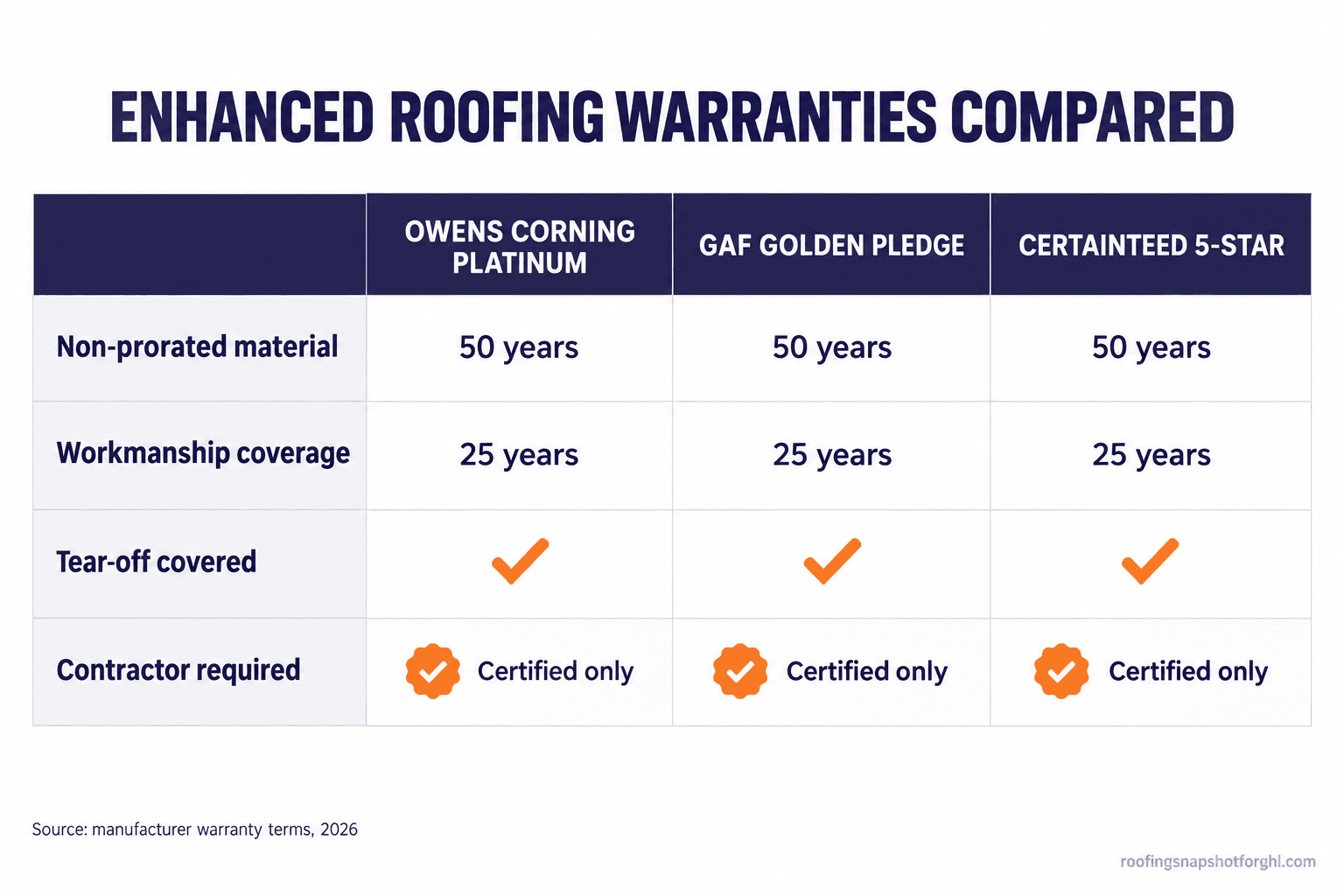
| Warranty | Non-prorated material | Workmanship coverage | Contractor required |
|---|---|---|---|
| Owens Corning Platinum Protection | First 50 years | Limited lifetime, reduced after 25 years | Platinum Preferred Contractor |
| Owens Corning Preferred Protection | First 50 years | First 10 years | Platinum or Preferred Contractor |
| GAF Golden Pledge | Lifetime, non-prorated extension | 25 years, plus tear-off and disposal | Master Elite |
| CertainTeed 5-Star (SureStart PLUS) | 50 years | 25 years, backed by CertainTeed | SELECT ShingleMaster |
| Any base manufacturer warranty | ~10 years (varies by line) | None | No certification needed |
Sources: Owens Corning, GAF, CertainTeed. The through-line is simple: the certification is the product. The difference between a 10-year base warranty and a 50-year, labor-backed, 25-year-workmanship warranty is not a better shingle. It is a contractor the manufacturer was willing to put its name behind.
Steal this: the warranty packet and registration SOP
Two things turn warranty from a liability into a closing tool: a clear written packet you hand every homeowner, and a registration process that never slides.
The one-page warranty summary to hand the homeowner, in plain language, in the folder at signing:
Your roof is covered by three separate warranties.
- Manufacturer material warranty. [Manufacturer] covers defects in the shingles for the limited lifetime of the product. Full replacement material for the first [X] years, prorated after. This covers the product, not installation.
- Workmanship warranty. [Your company] guarantees our installation for [X] years. If a leak or failure is caused by how we installed your roof, we fix it at no cost, parts and labor.
- Enhanced system warranty. Because we are a [certification] contractor, your roof qualifies for the [tier name] warranty, covering the complete system for [X] years non-prorated with [workmanship term] of labor coverage backed by [manufacturer]. We register this within [X] days and send you the confirmation. What voids coverage: unapproved repairs by another contractor, rooftop equipment installed incorrectly, or failure to maintain attic ventilation. Call us first before anyone else touches the roof.
The registration SOP, as pipeline steps:
- Job marked Complete auto-creates a Register Warranty task due inside the manufacturer’s window.
- The task is assigned to one named owner, not “the office.”
- Owner submits the registration and enters the confirmation number on the job record; the task cannot close without it.
- On confirmation, the system emails the homeowner their registered warranty plus the one-page summary.
- A dated note logs the coverage term and transfer window so it is searchable later.
- At the transfer window, an automated reminder confirms the homeowner knows the transfer option exists.
The crew documentation checklist, attached to every job: a photo of the nailing pattern on a representative course (proves wind-rating compliance), a photo of the installed ventilation and full accessory system, photos of valley and flashing details, and a note of the exact products installed so registration is accurate. Those assets are what stand between you and a denied claim, and they double as proof when an insurance claim touches the roof later.
Run it for a solo, a mid-size, and a large shop
Solo or two-truck shop. You probably are not certified yet, and that is your biggest competitive gap. Short term, win on a real, written workmanship warranty, make it five years when competitors offer one or two, honor it, and price the callbacks into your margin. Hand every homeowner the one-page summary, because most local competitors hand them nothing. Medium term, earn one manufacturer certification. It lets you sell the same 50-year labor-backed warranty the big regional outfit sells and removes price as the deciding factor.
Mid-size shop, three to ten crews. You likely carry a certification, so your problem is registering it consistently across crews and making sure every install meets the spec that keeps it valid. The leak is volume: in a busy month, registrations slide and nailing patterns drift. A tracked registration step and a photo-documentation requirement on every job close both gaps, and protect the certification itself, which the manufacturer can pull if quality slips.
Large or multi-location contractor. Your warranty exposure is a portfolio. Thousands of roofs sit under workmanship coverage, and the year-six curve means this year’s claims come from roofs you sold years ago. Treat warranty data as a metric: callback rate by crew, product, and region, so you see which crews generate future claims before they arrive. Tie it to your pipeline data and warranty becomes a quality signal you can manage, not a cost center.
What you can legally promise about a warranty
Warranty promises are governed, and breaking the rules turns a sale into a complaint. The federal baseline is the Magnuson-Moss Warranty Act, enforced by the FTC.
Offering a written warranty is optional, but once you offer one you must honor it. The FTC states “the Act does not require any business to provide a written warranty,” but “once a business decides to offer a written warranty on a consumer product, it must comply with the Act” (FTC). A written warranty on a product over $10 must be clearly titled “full” or “limited.” Roofing warranties are limited, and labeling one as a “full” or unconditional “lifetime” warranty when it is prorated and conditional invites a deception claim: “Deceptive warranty advertising is unlawful” (FTC).
The word “lifetime” has its own rule. The FTC’s advertising guides tell you to “clarify what you are talking about when you advertise a ‘lifetime’ warranty,” because it can mean the product’s life or the original purchaser’s life (FTC). On top of the federal rules, most states recognize an implied warranty of workmanlike construction and set a statute of repose, a hard cutoff often between six and fifteen years, after which a defect claim can no longer be brought. None of this is a reason to promise less. It is a reason to put exactly what you mean in writing, the same way you stay clear of the marketing-law traps that govern what roofers can say about insurance claims.
Objections
“The manufacturer warranty is good enough.” It covers the shingle, not your install, and your install is what fails. A homeowner with a leaking valley in year three has no manufacturer claim, because nothing was defective; your crew’s work was. Without a workmanship warranty, that homeowner’s only move is a review and a complaint.
“Nobody ever actually claims the workmanship warranty.” They do, just not on your timeline. The year-six average means claims land after most warranties expire, which is exactly why it feels like nobody claims them: they tried, found they were out of coverage, and left a one-star review instead. The quiet non-claims are the expensive ones.
“Getting certified costs money and takes time.” It does, and it is still the best return a small roofer can buy. Certification lets you sell a 50-year, labor-backed warranty your uncertified competitors cannot touch, and it comes with lead and co-marketing programs. Weigh the cost against one storm job lost to the company offering a Golden Pledge or Platinum roof.
“I already tell everyone it’s a lifetime warranty.” That is the one that should worry you. A spoken “lifetime warranty” that turns out to be prorated material with no labor is exactly the deceptive-promise problem Magnuson-Moss catches, and it is how a happy customer becomes a complaint to your state. Replace the porch promise with the written one-page summary; a clear document beats a vague claim.
Related reading
- The roofing customer communication system: the post-install cadence that fires warranty registration and the coverage summary automatically.
- Why signed roofing jobs stall before install: the production system where the registration and photo-documentation steps live.
- What roofers can and can’t legally say about insurance claims: the marketing-law sibling to the warranty-promise rules above.
- How to get more Google reviews for your roofing company: why covering a workmanship failure well protects the reviews warranty gaps destroy.
- Roofing sales pipeline stages: where warranty registration and callback tracking fit in the pipeline.
Frequently asked questions about roofing warranties
What is the difference between a manufacturer warranty and a workmanship warranty on a roof?
The manufacturer warranty covers defects in the roofing product itself and is usually limited lifetime but mostly prorated, and it rarely pays for labor. The workmanship warranty is the contractor's own promise to fix problems caused by how the roof was installed, such as a leak from a badly nailed valley. Installation is what fails most often, so the workmanship warranty is the one most likely to be claimed.
What does a 'lifetime' roofing warranty actually cover?
Usually less than it sounds. A limited lifetime manufacturer warranty covers defects in the shingle for as long as the original owner holds the home, with full material replacement for a short non-prorated window, often 10 years, then a prorated fraction after. It typically does not cover installation errors or, on base warranties, the labor to tear off and replace. The FTC requires advertisers to clarify whose 'lifetime' a warranty refers to.
Why do I need to be a certified contractor to offer the best roofing warranty?
The enhanced system warranties, Owens Corning Platinum, GAF Golden Pledge, and CertainTeed 5-Star, are only available through contractors the manufacturer has certified, such as a Platinum Preferred Contractor, Master Elite, or SELECT ShingleMaster. These extend the non-prorated material window to 50 years and add up to 25 years of workmanship coverage backed by the manufacturer. Without the certification, you can only offer the base warranty.
What voids a roofing manufacturer warranty?
Common reasons are an incorrect nailing pattern, inadequate attic ventilation, mixing non-matching accessories instead of the manufacturer's full system, installing over an old roof when a tear-off was required, and improper flashing. Most are installation decisions, which is why documenting the install with photos and following the manufacturer's published instructions for the specific warranty is essential.
Do I have to register a roofing warranty, and what happens if I don't?
Enhanced manufacturer warranties must be registered with the manufacturer, usually within a set window after installation. If you do not register, the enhanced coverage the homeowner paid for does not exist, and they are left with only the base warranty. Registration also governs whether the warranty can transfer to a future homeowner, a resale selling point an unregistered warranty cannot deliver.
How long should a roofing contractor's workmanship warranty be?
Industry norms run one to five years, but that is often shorter than the time installation problems take to appear, which the NRCA puts at an average of around year six. A longer standalone workmanship warranty, five or ten years, is a strong closing tool and better matches real failure timing. If you are a certified contractor, the enhanced warranty's 25-year workmanship coverage is stronger still because the manufacturer co-signs your installation.