
It is a Thursday morning and your crew is standing in the yard drinking coffee because the job you promised them fell through at 6:40 a.m. The shingles never showed. The homeowner you signed three weeks ago just called, annoyed, asking when somebody is actually going to start, because the tarp over the garage is leaking again. You pull up the folder. The contract is signed, the deposit cleared, and nothing has moved since. No material order, no permit, no delivery date, no crew slot. The money is sitting on a finished sale and rotting.
Here is the short answer, so you can stop blaming your supplier. A signed roofing job rarely stalls for one big reason. It stalls at seven predictable handoffs between the signature and the crew on the roof, each a step that should have fired automatically the minute the homeowner signed. Nothing triggered the material order. Nobody locked the measurements. The permit never got filed. The crew calendar is a group text. And while all of that drifts, the homeowner sits in silence and starts wondering if they picked the wrong roofer. This post walks all seven and gives you the exact system, and the exact messages, that move a signed contract to a finished roof without a month of dead air.
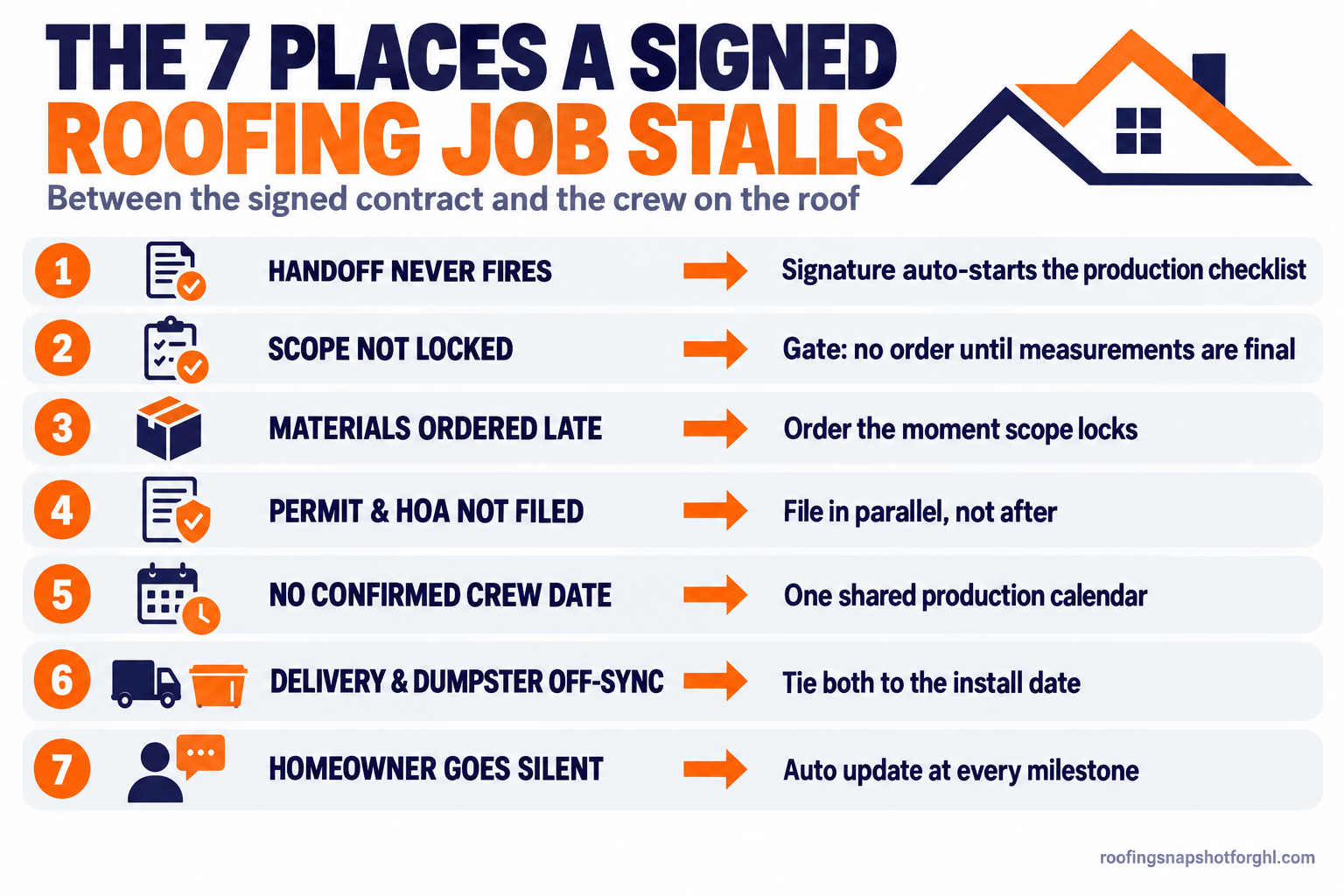
Key Takeaways
- The stall is in the handoff, not the supplier. A signed job dies in the gap between sales and production, where steps that should fire automatically wait on somebody to remember them. Fix the handoff and most delays vanish.
- A sitting job is expensive. Angi’s 2025 data puts an average roof replacement around $9,516, most jobs between $5,867 and $13,210 (Angi). That is the revenue parked on every contract that drifts, plus a crew you still pay.
- Homeowners quit over silence, not price. In a 2025 survey of 1,000 homeowners, poor communication and scheduling was the top frustration at 38%, nearly double higher-than-expected cost at 21% (FIELDBOSS via Contracting Business). A quiet signed job is a cancellation waiting to happen.
- Idle crews cost more every year. Construction needed an estimated 439,000 net new workers in 2025 (ABC via Construction Dive). A crew standing in the yard is money you burn twice.
Table of contents
- What a stalled signed job actually costs you
- The production gap at a glance
- Stage 1: The handoff never fires
- Stage 2: Scope and measurements are not locked
- Stage 3: Materials get ordered late or wrong
- Stage 4: Permit and HOA approval never started
- Stage 5: No confirmed crew date
- Stage 6: Delivery and dumpster are not coordinated
- Stage 7: The homeowner goes silent and gets cold feet
- Run production for a solo, mid-size, and large shop
- Steal this: the signed-to-installed message sequence
- Keep it legal: TCPA and storm-state claims law
- Objections
- Related reading
- FAQ
What a stalled signed job actually costs you
Start with the number on the contract. Angi’s 2025 cost data puts the average roof replacement at about $9,516, with most jobs between $5,867 and $13,210 (Angi). That is not a lead. That is a sold, signed, deposit-paid job. When it sits for three weeks because nobody ordered shingles, you have roughly ten thousand dollars of booked revenue frozen, and the longer it sits, the more it looks like a refund.
Now add the crew. The industry needed an estimated 439,000 net new workers in 2025, down from 501,000 the year before but still a deep hole (ABC via Construction Dive). When your crew shows up to a job that is not ready, you pay them to drink coffee, lose the day you could have billed, and give your best installers a reason to go work for the shop that keeps them busy.
What one signed roof replacement is worth in 2025, low to high. Source: Angi 2025 roof replacement cost data. That is the revenue parked on every contract that stalls in production.
Then there is the homeowner, the biggest risk of all. A signed contract is a decision they can still unwind, and silence is what makes them do it. In a 2025 survey of 1,000 homeowners, poor communication and scheduling was the number one frustration at 38%, nearly double the 21% who named higher-than-expected cost (FIELDBOSS via Contracting Business). Roofing Contractor’s own homeowner survey found roughly a quarter name poor communication and lack of updates as a top pain point (Roofing Contractor). A storm homeowner with a tarped roof and no start date is a cancellation that has not happened yet.
Every one of those costs traces to the same root: the gap between “they signed” and “the crew is on the roof” is run by memory and a group text instead of a system.
The production gap at a glance
Think of the time between the signature and the first nail as a relay race. The sale is the first runner, the crew is the last, and in most shops the baton gets dropped in the middle because the handoffs live in somebody’s head. The salesperson assumes the office ordered materials, the office assumes the salesperson got final measurements, and the crew finds out the night before that tomorrow is cancelled. There are seven places that baton gets dropped. The rest of this post walks each one and tells you exactly what should fire, automatically, the moment the step before it finishes.
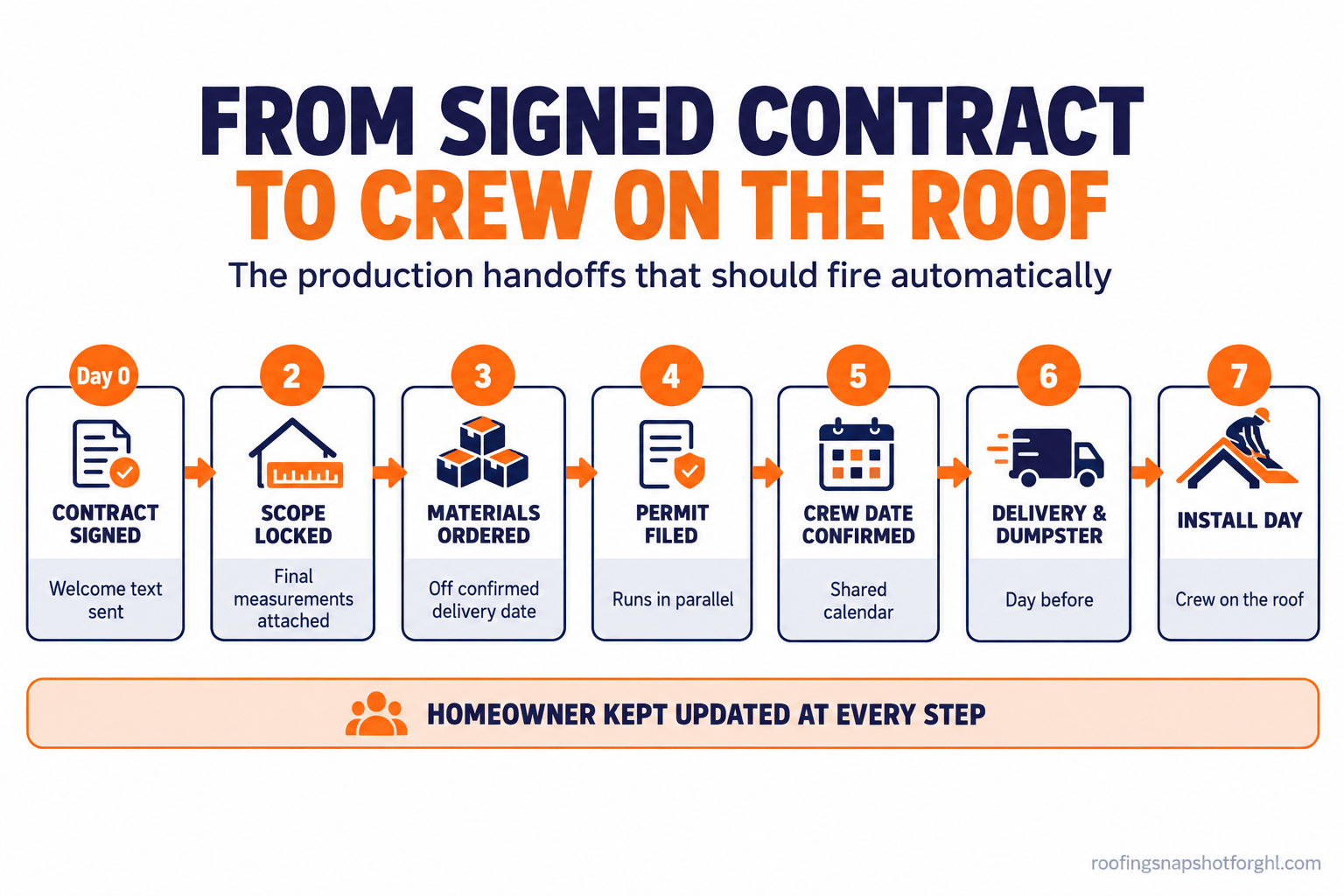
Stage 1: The handoff never fires
The job stalls before anything else can start, because signing the contract did not trigger a single task. The salesperson closes on the porch, shakes hands, drives to the next appointment, and the deal lives in a text thread or a photo of a paper contract on a phone. Nobody in the office knows the job exists yet, so the clock that should start the minute the homeowner signs does not start for days.
How it breaks, and the fix. It breaks when “handing off the job” means the salesperson remembering to tell the office, which during a busy week never happens cleanly. The fix is to make the signature itself the trigger: when the contract is signed, the pipeline moves the job from Sold to Production automatically, creates the production checklist, assigns an owner, and pings the office. No human has to remember, because the system does. That handoff is the whole reason a roofing sales pipeline with real stages beats a spreadsheet, and it is exactly the job that dies when your tools are disconnected and nothing talks to anything else.
Stage 2: Scope and measurements are not locked
You cannot order materials until you know exactly what the roof needs, and on a lot of signed jobs that final number is still fuzzy. The sales measurement was a drone estimate from the inspection, the scope changed when the homeowner added the detached garage, and the supplement is still open with the carrier so the line items are not final. Materials cannot be ordered against a moving target, so the job waits while the scope settles, except nobody is actively settling it.
How it breaks, and the fix. It breaks when “lock the scope” is nobody’s assigned task, so it drifts until the crew is standing on the roof wondering why there are not enough bundles. The fix is a hard gate in the pipeline: the job cannot advance to Order Materials until the final measurements, the signed scope, and the approved insurance amount are attached to the record. On storm jobs that means the claim and any supplement are squared away first, a battle covered in why roofing insurance claims stall and how to get supplements approved faster. Lock the scope once, order against it with confidence.
Stage 3: Materials get ordered late or wrong
This is the stall your crew feels on install morning. The order went in late, or for the wrong color, or the supplier is backed up and nobody checked the lead time before promising a date. As of mid-2026, standard shingles and metal were generally shipping within a few weeks, but trucking shortages were pushing some full-truck orders out to two to six weeks, and the big three shingle makers all raised prices in early 2026 (ServiceTitan; Roofing Contractor). Specialty products take longer. If you promise a Tuesday install and order Thursday-arriving materials on Monday, you built the stall into the job yourself.
How it breaks, and the fix. It breaks when ordering is a manual task somebody does when they get to it, with no check against the real lead time. The fix is to make the material order fire the moment the scope locks, off a standard order template per roof type, and to set the promised install date from the confirmed delivery date rather than a guess. The system creates the purchase order, logs the expected delivery, and will not let the crew date be set earlier than the materials can arrive.
Stage 4: Permit and HOA approval never started
Plenty of jobs sit for a week waiting on a permit nobody filed, or an HOA approval nobody submitted. These are not hard steps. They are easy to forget because they happen off to the side, and the homeowner usually does not know they are needed. The job looks ready, materials are coming, the crew is slotted, and then you learn the municipality needs three business days and the HOA meets twice a month.
How it breaks, and the fix. It breaks when permitting is tribal knowledge, remembered for the jurisdictions you work most and forgotten for the one new suburb. The fix is to build the permit and HOA check into the production checklist as a required task with an owner and due date, triggered as soon as the job enters production so it runs in parallel with the material order instead of after it. On a storm job you can file the permit while the supplement is still closing.
Stage 5: No confirmed crew date
Here is the black hole in most shops: the crew schedule is a group text, a whiteboard, and the owner’s memory, none of which agree. The job is “on the schedule” in the sense that you intend to do it soon, but there is no confirmed date the homeowner, the crew, and the dumpster company all share. So the job floats, getting bumped every time a louder job jumps the line, and the homeowner you signed three weeks ago keeps sliding because they stopped calling.
How it breaks, and the fix. It breaks when scheduling is verbal, first-come-whoever-yells-loudest, with no single source of truth. The fix is one shared production calendar where a confirmed install date is a real event tied to the job record, visible to the office, pushed to the crew, and not set until materials and permit are both green. When the date is set, the system confirms it to the homeowner and the crew in the same motion. This is the discipline that keeps your crews booked instead of idle between storms: a full, honest calendar instead of a pile of vague intentions.
Stage 6: Delivery and dumpster are not coordinated
Install day has three deliveries that have to land in the right order: the materials, the dumpster, and the crew. Get them out of sync and you lose the day. The dumpster shows up late, so there is nowhere to throw the tear-off. The materials land on the day the crew is somewhere else. The crew arrives to a driveway with no dumpster and a pallet of shingles still at the yard. Each of these is a phone call somebody forgot to make.
How it breaks, and the fix. It breaks when delivery coordination is three separate memories instead of one checklist. The fix is to tie the dumpster order and the material delivery to the confirmed install date as automatic tasks, scheduled to land the day before, with a confirmation the morning of. The crew gets a dispatch the night before with the address, the scope, the dump location, and a photo of the house, so they roll up to a job that is actually ready.
Stage 7: The homeowner goes silent and gets cold feet
While all six stages above drift, the homeowner sits at home with a signed contract, a deposit gone, and no idea what is happening. That silence is the most dangerous part of the whole gap. Remember the survey: communication and scheduling, not price, is the top homeowner frustration at 38% (FIELDBOSS via Contracting Business). A homeowner who has not heard from you in two weeks starts reading your bad reviews and wondering if the check cleared to a company about to ghost them. Some cancel. Some file a complaint. All of them stop referring you.
How it breaks, and the fix. It breaks when you only talk to the homeowner when there is a problem, so no news reads as bad news. The fix is a short, automatic update at every milestone: materials ordered, date confirmed, day-before reminder, morning-of heads-up, job-complete wrap. None of it requires you to remember, and all of it turns a nervous customer into one who leaves a five-star review and sends their brother-in-law. That cadence is the backbone of a real roofing customer communication system, and where a strong Google review pipeline starts.
Top homeowner frustration with home-services work, 2025 survey of 1,000 homeowners. Source: FIELDBOSS via Contracting Business. Silence costs you more signed jobs than your price does.
Run production for a solo, mid-size, and large shop
The seven stages are the same at every size. Who runs them changes, and so does what you automate first.
The solo operator. You are the salesperson, the scheduler, and sometimes the crew. Your gap is pure overload: you close on a porch at 7 p.m. and the material order competes with forty other things in your head. Automate the handoff and the homeowner updates first, because those are the two that fail when you are on a roof. When the contract is signed on your phone, the system fires the material-order task to your own queue and starts the homeowner texts without you.
The mid-size shop (office manager, two or three crews). The gap is the handoff between sales and the office, where your office manager is reconstructing the job from a text thread. Automate the pipeline stages and the shared calendar: the signed job appears in production with a checklist, the office manager works the queue, and the crew sees confirmed dates instead of a nightly scramble. This is where a real pipeline pays for itself fastest, because you are big enough to drop jobs and small enough that one dropped job hurts.
The large shop (production coordinator, four-plus crews). Your gap is volume and visibility. With dozens of jobs in production, a stalled one hides in the pile until the homeowner calls angry. Automate the reporting and alerts: any job that sits in a stage past its expected days flags itself, so the coordinator manages exceptions instead of chasing everything. The metric that matters, days from signed to installed, belongs on a dashboard, which is the point of tracking the right roofing KPIs.
Steal this: the signed-to-installed message sequence
Here is the exact homeowner cadence that turns a nervous signed job into a confident one. Every message is short, plain, and fires automatically off the production stage it belongs to. Swap in your company name and details.
- The minute they sign (welcome and what happens next): “Hi [First name], it’s [Company] confirming your roof is officially on our schedule. Here’s what happens next: we lock your final measurements, order your materials, and confirm your install date. We’ll text you at every step, so you’re never guessing. Reply here anytime with questions.”
- Materials ordered: “Good news [First name], your materials are ordered. We’re expecting delivery around [date]. Once that’s confirmed we’ll lock your install day and send it over. Everything is moving.”
- Install date confirmed: “Your roof is scheduled for [date]. The crew will arrive around [time]. Please clear vehicles from the driveway the night before and we’ll handle the rest. We’ll send a reminder the day before.”
- Day before: “Reminder: your roof install is tomorrow, [date]. The crew arrives around [time], and a dumpster will be dropped this afternoon. Please move cars out of the driveway tonight. Text us with any last questions.”
- Morning of: “The crew is on the way to [address] and should arrive by [time]. Today is loud and busy but we’ll keep the site clean. Your project manager is [name] at [number] if you need anything.”
- Job complete (wrap and review ask): “Your new roof is done. We did a full cleanup and magnet sweep for nails. [Name] will walk the final punch list with you. When you have a minute, a quick Google review really helps a local company like ours: [review link].”
And the two internal pieces that keep the crew and the yard in sync:
- Crew dispatch, sent the night before: “Tomorrow: [address], [roof type], [squares], tear-off [yes/no]. Materials delivered [location]. Dumpster on site. Arrive [time]. Scope and photos in the job: [link]. Call [office] if anything’s off.”
- Material-order checklist (gate before you order): final measurements attached; signed scope attached; approved insurance amount confirmed on storm jobs; shingle line and color confirmed with the homeowner; accessories counted (underlayment, ridge, pipe boots, drip edge, flashing); supplier lead time checked in writing; delivery address and drop location noted.
That is roughly a dozen touches that used to live in your head, now running on their own. For the compliant storm-lead side of the same engine, the earlier texts that get you to the signature in the first place are in the storm lead follow-up sequence.
Keep it legal: TCPA and storm-state claims law
Automating homeowner messages does not exempt you from the rules. Two of them govern everything above.
TCPA and consent. Even service and update texts are safest sent with clear consent, captured when the homeowner signs or hands you their number, and every automated message needs a working STOP you honor instantly. TCPA penalties run $500 to $1,500 per message, so never fold a bought or scraped list into the same system. US carriers also block unregistered application-to-person texting, so register your number through A2P 10DLC first, covered in A2P 10DLC registration for roofing contractors.
Storm-state claims law. On insurance jobs, your production messages have to stay on the right side of state law. In a growing list of storm states you cannot negotiate the homeowner’s claim or offer to pay, rebate, or absorb their deductible, under statutes like Wisconsin’s 2013 Act 24 and Florida Statute 489.147. Your updates can confirm the schedule, document the work, and keep the homeowner informed. They cannot represent the homeowner to the carrier or promise a free roof. The full map is in what roofers can and cannot legally say about insurance claims.
Objections
“My jobs stall because of suppliers and permits, not my office.” A CRM will not make a shingle truck arrive faster. It stops you from building the delay into the job yourself. Most stalls are not the supplier being slow, they are you ordering late, promising a date before materials are confirmed, or forgetting the permit until install week. Gating the order behind a locked scope and setting the install date off a real delivery date removes the self-inflicted half of the delay, which is usually most of it.
“I already pay for AccuLynx or JobNimbus. Doesn’t that handle production?” Those tools have production scheduling, and if yours is fully set up and your team works it, good. The problem in most shops is not the absence of a tool, it is a sales pipeline in one place, texts in another, and the crew schedule in a group chat, so the handoffs still break between systems. The point here is one connected flow from signed to installed with the homeowner messaging built in, not another login nobody opens.
“I run a three-person shop. I don’t have a production coordinator.” That is why you automate it. You will never hand-text six updates to every customer and remember every permit during a storm week. The system is your production coordinator: it fires the handoff, queues the order, flags the permit, and sends the updates while you are on a roof.
“Won’t automated updates feel robotic to the homeowner?” Only if you write them like a robot. The sequence above is plain and human, and it sends at the moments a homeowner wants to hear from you. Homeowners do not complain about too many clear updates, they complain about silence. A timely “your materials are ordered” text reads as a company that has its act together.
Related reading
- Roofing sales pipeline stages that actually move jobs: the stage structure that makes the signed-to-production handoff fire on its own.
- Why disconnected roofing software quietly costs you jobs: what happens when sales, texts, and the crew schedule live in three places that never talk.
- The roofing customer communication system: the homeowner cadence behind the production updates in this post.
- Why roofing crews sit idle between storms: the scheduling discipline that keeps the calendar full instead of lumpy.
Frequently asked questions about signed roofing jobs that stall before install
Why do signed roofing jobs take so long to start?
Almost always because of a broken handoff, not a slow supplier. Signing the contract does not automatically trigger the next steps, so the material order, permit, and crew scheduling wait on somebody to remember them. During a busy week that memory fails, and the job drifts for weeks. Making the signature trigger the production checklist automatically removes most of the delay.
How long should it take to go from a signed roofing contract to installation?
On a cash job with materials in stock, a well-run shop can be on the roof within one to two weeks. The main variables are material lead time, which in mid-2026 ran from a few weeks up to two to six weeks on some full-truck orders, and permitting. On storm jobs you also wait on the claim and any supplement to finalize before you can order. The key is to set the install date from a confirmed delivery date, not a hopeful guess.
What is the production gap in a roofing business?
It is the stretch between a signed contract and the crew on the roof, where jobs stall at seven predictable handoffs: the sales-to-production handoff, locking the scope, ordering materials, permit and HOA approval, confirming the crew date, coordinating delivery and dumpster, and keeping the homeowner informed. Each one should fire automatically off the step before it.
How do I keep a homeowner from cancelling a signed roofing job?
Keep them informed. A 2025 survey found communication and scheduling, not price, is the top homeowner frustration at 38 percent. Send a short automatic update at every milestone: materials ordered, date confirmed, day-before reminder, morning-of heads-up, and a job-complete wrap. A homeowner who hears from you regularly rarely cancels, while one left in silence talks themselves out of it.
Is it legal to send automated text updates to roofing customers?
Yes, with consent and guardrails. Capture consent when the homeowner signs or gives you their number, include a working STOP in every automated message and honor it immediately, and register your number through A2P 10DLC so carriers deliver your texts. TCPA penalties run $500 to $1,500 per message. On insurance jobs, keep updates to scheduling and documentation, and never offer to negotiate the claim or absorb the deductible, which is illegal in several storm states.