
It is the morning after a hail line rolls through, and your best door-knocker sends you the script he wants to run: “We handle the whole insurance claim for you, and we’ll cover your deductible so it costs you nothing out of pocket.” It sounds like a closer. In most storm states it is two separate crimes in one sentence, and the second one is a felony.
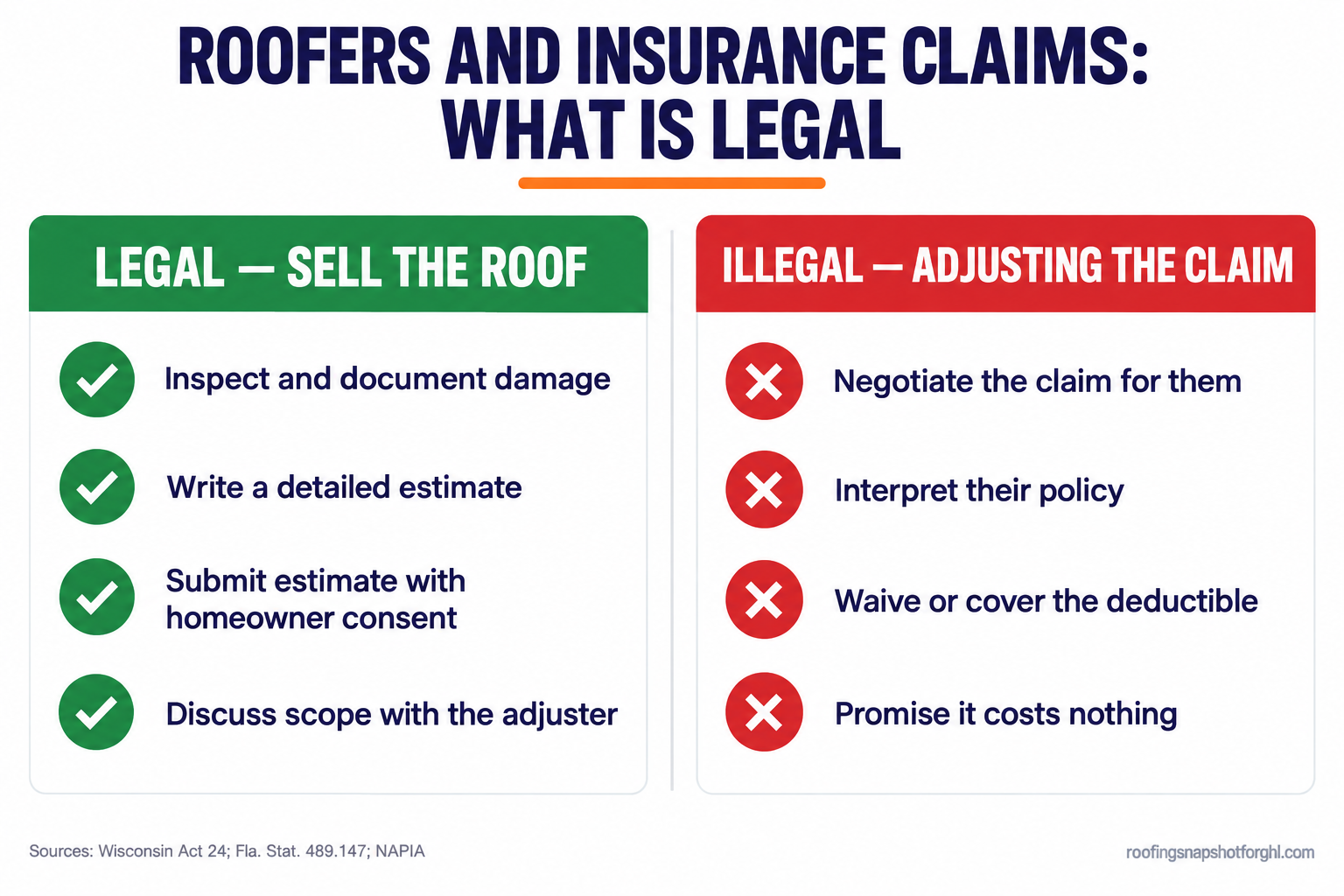
Here is the short answer. A roofing contractor can inspect a roof, write an estimate, submit that estimate to the homeowner’s insurer with the homeowner’s permission, and talk through the scope with an adjuster. A roofing contractor cannot negotiate or “handle” the claim on the homeowner’s behalf, and cannot pay, waive, rebate, or absorb the deductible. The first crosses into unlicensed public adjusting, which is illegal in nearly every state. The second is banned outright in at least 28 states, and in Florida it is prosecuted as third-degree felony insurance fraud (Florida Statutes 489.147). This guide walks the exact line, state by state, and hands you follow-up copy that closes storm jobs without stepping over it.
Key Takeaways
- Sell the roof, don’t adjust the claim. You may estimate, document, and submit with the homeowner’s consent. Negotiating the claim for them is unlicensed public adjusting, illegal in every state except the four that don’t license adjusters at all (NAPIA).
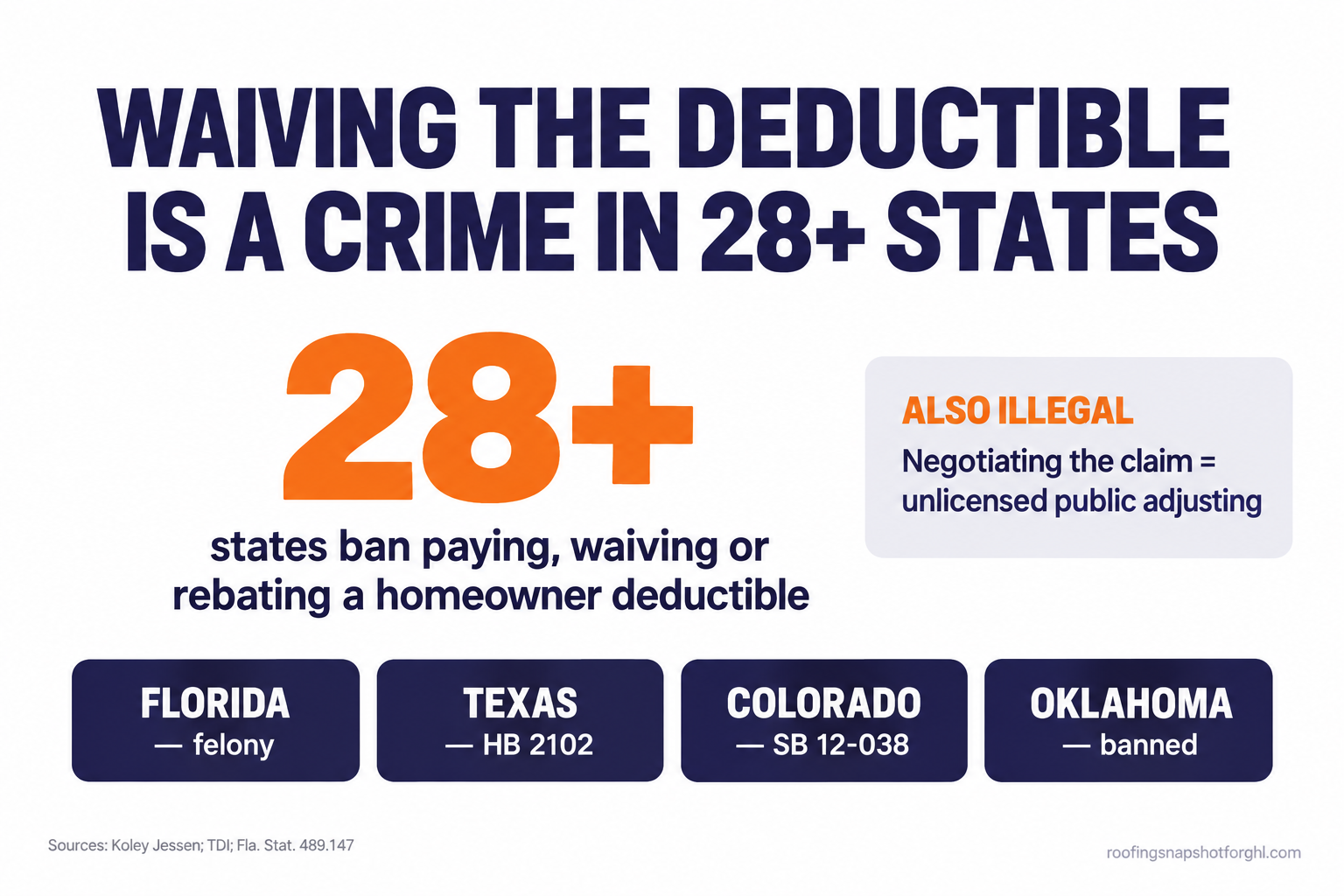
- “We’ll cover your deductible” is illegal in at least 28 states. Waiving or rebating a deductible is a fraud statute, not a marketing gray area (Koley Jessen). In Florida it’s a third-degree felony (Fla. Stat. 489.147).
- Wisconsin bans the negotiation itself. 2013 Wisconsin Act 24 bars residential contractors from representing or negotiating a roof insurance claim on a consumer’s behalf, and from promising to rebate the deductible.
- Your storm follow-up texts are regulated too. TCPA and A2P 10DLC govern every automated text you send. Unsolicited automated texts run $500 per message, up to $1,500 for willful violations (47 U.S.C. 227).
- The fix is copy, not silence. You can market hard and follow up fast. You just phrase it around the roof and the estimate, never the claim and the deductible. Steal-this templates are below.
Table of contents
- Why this suddenly matters more in 2026
- The one distinction that keeps you out of court
- What getting it wrong actually costs
- The deductible trap: why “we’ll cover it” is a crime
- The public-adjusting line: what “we handle your claim” really means
- State-by-state: how the rules differ where you work
- The solicitation-law twist most sites get wrong
- TCPA and A2P 10DLC: your storm follow-up is regulated too
- Steal this: compliant copy for the whole storm funnel
- Three scenarios: solo, mid-size, multi-state
- Objections
- FAQ
Why this suddenly matters more in 2026
Storm volume is not slowing, and neither is enforcement. The United States logged 5,432 large-hail reports in 2025, up slightly from 5,373 in 2024 (Insurance Information Institute, citing NOAA’s Storm Prediction Center). Every one of those events pulls out-of-state crews, spins up new door-knocking outfits, and floods homeowners with pitches. States wrote these laws precisely because the storm-chase gold rush produced deductible-waiver scams and contractors “adjusting” claims they had no license to touch.
Large-hail reports in the US, 2024 vs 2025. Storm volume keeps the door-knock market crowded, which is why claims-marketing laws keep getting tighter. Source: Insurance Information Institute citing NOAA Storm Prediction Center.
The money is real enough to attract that crowd. State Farm alone paid more than $3.5 billion in hail claims in 2022 (Insurance Information Institute). When one job clears five figures, a fine feels like a cost of doing business to a fly-by-night crew. It should not to you, because the roofer who plans to be in the same market next season is the one regulators can actually find.
The one distinction that keeps you out of court
Every rule in this guide comes back to a single line: you sell and build roofs, you do not adjust insurance claims.
On the legal side, you can inspect the roof and document damage, prepare a repair or replacement estimate, give it to the homeowner, submit it to their insurer with the homeowner’s express permission, and talk through the scope of work with the homeowner or the adjuster. Wisconsin spells this out almost word for word: even under one of the strictest statutes in the country, a residential contractor may, with the insured’s express consent, discuss the damage, provide an estimate, submit it, and discuss repair options (2013 Wisconsin Act 24).
On the wrong side is anything that looks like representing the homeowner as their claims agent: negotiating the settlement, interpreting the policy for them, advising them whether to accept the insurer’s offer, or promising to make the claim “cost them nothing.” That is the work of a licensed public adjuster, and doing it without a license is a crime in nearly every state (NAPIA).
What getting it wrong actually costs
This is not a paperwork violation with a slap on the wrist. Deductible waiving is prosecuted as third-degree felony insurance fraud in Florida when done knowingly (Fla. Stat. 489.147). Unlicensed public adjusting is a third-degree felony under Florida Statute 626.8738, and in Iowa it is a class D felony on top of which the homeowner’s contract is void if the contractor negotiated the claim (NAPIA). A void contract means you did the tear-off and the reroof and have no enforceable agreement to get paid on.
Even where the charge is not a felony, the collateral damage adds up: licensing-board discipline, restitution, the deal unwound, and in several states an automatic right for the homeowner to cancel. The marketing channel has its own price tag too. Send automated texts without consent and the Telephone Consumer Protection Act sets damages at $500 per message, rising to $1,500 for willful violations (47 U.S.C. 227). Run one 1,000-contact “storm alert” blast to a list that never opted in and the math is brutal.
TCPA statutory exposure on a single 1,000-contact text blast sent without consent, at $500 and $1,500 per message. This is why door-knock follow-up runs on opt-in, not on a scraped list. Source: 47 U.S.C. 227.
The deductible trap: why “we’ll cover it” is a crime
The deductible pitch is the most common way good roofers get in trouble, because it feels like generosity, not fraud. The homeowner owes a $2,000 deductible, the job is $18,000, and “don’t worry about the deductible” seems like a nice way to win it. It is illegal in at least 28 states (Koley Jessen). The reason is simple: the deductible is the homeowner’s share of risk that the insurer priced the policy around. If you eat it, you have inflated the claim and the insurer is paying for a loss the homeowner never shared. That is the fraud.
The laws are not subtle. Colorado made waiving deductibles illegal in 2012 under Senate Bill 12-038. Texas passed House Bill 2102 in 2019, barring a contractor from paying, waiving, rebating, or absorbing a deductible. Oklahoma added its own ban (Roofing Contractor), and Nebraska followed (Koley Jessen). Wisconsin bans the promise itself, including in advertising (Act 24).
Watch the disguised versions, because those are what get flagged. A “free upgrade,” a “storm discount” that happens to equal the deductible, a gift card at signing, or “we’ll build the deductible into the supplement” are all the same offense in a costume. Florida writes it out explicitly: a contractor may not offer a rebate, gift, gift card, cash, coupon, or waiver of any deductible in exchange for the inspection or the claim (Fla. Stat. 489.147).
The public-adjusting line: what “we handle your claim” really means
“We handle the insurance for you” is the phrase every homeowner wants to hear and the one most likely to end with a letter from the state. Adjusting a claim, meaning representing the policyholder’s interest in negotiating the settlement, is a licensed profession. Public adjusters must be licensed in every state except Alabama, Alaska, Arkansas, and South Dakota, which do not license them at all (NAPIA). A roofing license, a general contractor license, even decades of storm experience, none of it lets you negotiate a claim on the homeowner’s behalf.
The tell is who you are representing. Writing your estimate and defending your scope of work is representing yourself, which is fine. Calling the carrier to argue the homeowner deserves a bigger settlement, interpreting their coverage, or telling them whether to accept an offer is representing the homeowner, which is public adjusting.
This is where roofers drift, especially on supplements. Submitting a supplement for legitimate scope you found during the tear-off is estimating your own work. Getting on the phone to negotiate the total payout for the homeowner is not. Keep supplements tied to documented, photographed roof scope and route the money conversation back to the homeowner and their carrier. If you want supplements to move faster, the fix is documentation and cadence, not negotiation, which we broke down in the insurance claim follow-up system.
State-by-state: how the rules differ where you work
The mistake is assuming one script works everywhere. It does not, because the same crew driving from Texas to Florida to Georgia crosses three different rulebooks in a week. Here is how a handful of common storm states line up. Always confirm the current statute before you run a campaign, because these laws change most years.
| State | Waive/rebate deductible? | Contractor negotiate the claim? | Notable rule to know |
|---|---|---|---|
| Florida | Banned, third-degree felony | No, unlicensed adjusting is a felony | Mandatory contract notice; homeowner can void within 10 days if it’s missing (489.147) |
| Texas | Banned (HB 2102) | Restricted; can’t act as adjuster | TDI publishes the rules for homeowners, so your customers can check you |
| Colorado | Banned since 2012 (SB 12-038) | No | Written contract and rescission-right requirements |
| Wisconsin | Banned, including in ads | No, negotiation itself is barred | Estimate-and-submit with consent is expressly allowed (Act 24) |
| Oklahoma | Banned (2022 law) | Restricted | Deductible-waiver ban is recent, so old scripts are now illegal |
| Georgia | Deductible rules still apply | No, adjusting still licensed | No state roofing license, but that does not exempt you from claims law |
Two things stand out. Georgia has no statewide roofing license at all, which fools operators into thinking “unlicensed state” means “anything goes.” It does not: the public-adjusting and deductible rules still apply, so the claim side is regulated even where the trade side is not. And Wisconsin is the clearest map of the safe zone, banning negotiation and deductible promises while listing the estimate-and-submit steps you are allowed to take. When unsure what is permitted, Wisconsin’s Act 24 reads like a checklist of the legal moves.
The solicitation-law twist most sites get wrong
Here is the nuance almost every roofing blog fumbles. Florida’s 2021 law (SB 76, which created 489.147) did two things: it banned deductible waiving, and it restricted how contractors could solicit homeowners to file roof claims. The second part got challenged fast. In Gale Force Roofing and Restoration LLC v. Brown, a federal judge in the Northern District of Florida enjoined the “prohibited advertisement” provisions in July 2021, finding they likely violated contractors’ First Amendment commercial-speech rights, and the state did not keep defending that piece (Insurance Journal). So the takeaway most sites miss: the advertising restriction was knocked down, but the deductible-waiver ban and the mandatory contract notice were not. You can market roof inspections to storm-hit neighborhoods. You still cannot waive the deductible, and you still have to include the contract notice.
TCPA and A2P 10DLC: your storm follow-up is regulated too
Say the words are clean. There is still the channel. The fastest roofers win storm jobs on speed-to-lead and text follow-up, and both live under federal telecom rules that carriers now enforce automatically.
The Telephone Consumer Protection Act requires prior express consent before you send automated marketing texts, with damages of $500 to $1,500 per message (47 U.S.C. 227). On top of that, US carriers require every business sending application-to-person texts to register the brand and campaign through A2P 10DLC, or the messages get filtered before they reach a homeowner. You cannot skip it by “just using your cell,” because the carriers police the network, not just the regulators.
For door-knock follow-up, the safe pattern is simple: capture explicit opt-in at the door (a tablet checkbox, a signed line, or a keyword the homeowner texts you), log it with a timestamp, and only then start the sequence. That single step converts a risky “storm list” into a compliant program. We wrote the full walkthrough in A2P 10DLC registration for roofing contractors, and the timing and templates in SMS marketing for roofing contractors.
Steal this: compliant copy for the whole storm funnel
This is the part to bookmark. Every line below is written to sell hard and stay legal. Swap in your details, keep the structure.
Door-knock opener (spoken):
“We’re doing free storm inspections in the neighborhood after last week’s hail. If we find damage, I’ll write you a detailed estimate and, with your okay, send it straight to your insurance company. You handle your claim with your carrier, I handle the roof. Want me to take a look?”
Missed-call auto-text (fires when a storm lead calls and you can’t pick up):
“Thanks for calling [Company]. Sorry we missed you, we’re up on a roof. Reply here and we’ll get your free storm inspection booked today. Reply STOP to opt out.”
Storm follow-up sequence (only to leads who opted in at the door or by text):
Text 1, same day: “Hi [Name], thanks for letting us inspect your roof today. We found [storm damage / no damage]. Want the written estimate emailed or texted?”
Text 2, day 2: “Sent your estimate over. Happy to walk through the scope anytime. Any questions before you file with your carrier?”
Text 3, day 5: “Checking in, [Name]. When you’re ready to move forward we can schedule the work as soon as your claim is approved. No rush, just here when you need us.”
The deductible line (say this, not “we’ll cover it”):
“Your deductible is set by your policy and it’s yours to pay, I can’t legally cover it. What I can do is give you a clean estimate and financing options so the out-of-pocket is manageable.”
Contract notice (required in states like Florida):
Include the statutory notice verbatim from your state’s law. In Florida, the contract must state that the contractor may not engage in the prohibited practices in 489.147, or the homeowner can void the contract within 10 days (Fla. Stat. 489.147).
Review request (same day as the final inspection):
“Roof’s done and it looks great, [Name]. If you were happy with the crew, a quick Google review helps other neighbors find us after the next storm: [link]. Thank you.”
Notice what is missing: no promise to handle the claim, no promise about the deductible, and no automated text without opt-in. That is the whole compliance strategy in a page of copy. To wire these to fire automatically off each pipeline stage, we mapped the stages in the roofing sales pipeline guide.
Three scenarios: solo, mid-size, multi-state
The same rules land differently depending on how you are built.
The solo or one-crew shop. Your risk is the door script, because it lives in your head and your rep’s head, not in a document. The fix is cheap: write the opener above on a card, put the deductible line on the tablet, and capture opt-in before any text goes out. You do not need a compliance department. You need one clean script and the discipline to use it. Your biggest exposure is a rep freelancing “don’t worry about the deductible” to close a wobbly deal.
The mid-size, three-to-five-crew operation. Now the risk is inconsistency across crews. One rep says the compliant thing, another says the felony thing, and you cannot see which. This is where a connected insurance-claim tracking system earns its keep: standardized templates every crew sends from the same pipeline, consent logged with a timestamp, and supplements tied to photo documentation instead of phone negotiation. You make the safe behavior the default so nobody has to remember the rule, and the tooling cost is trivial next to one voided contract on a $20,000 job. If you are deciding what to run it on, we compared the options in what roofing software actually costs in 2026.
The multi-state or storm-chasing operation. Your risk multiplies because you cross rulebooks. A deductible line merely frowned on in one state is a felony two states over, and Georgia’s lack of a roofing license lulls crews into thinking claims rules do not apply. You need state-aware templates, so the script changes based on where the job is, plus a hard rule that no one negotiates a claim anywhere. Build the location logic into the CRM so the Florida rep gets the Florida contract notice automatically. Manual is how a multi-state crew ends up on the wrong side of a statute it never read.
Objections
“Everybody in my market covers the deductible. If I don’t, I lose the job.” Some of them are committing a crime, and the enforcement wave is thinning that crowd. You compete on being the roofer who explains the number honestly, offers real financing, and is still in business next season to honor the warranty. Homeowners burned by a deductible-waiving fly-by-night are actively looking for you.
“This is just lawyer paranoia. Nobody gets charged.” Florida runs sting operations on unlicensed adjusting, and the charge is a felony (NAPIA). Texas publishes the rules straight to homeowners so your customers can check you (TDI). The roofer who plans to keep a license and a business is the easy one to find, which is exactly why rule-followers get made an example of. The paranoia is cheap. The felony is not.
“So I can’t help with insurance at all?” You can help plenty: inspect, document, estimate, submit with consent, and explain the process clearly. All of it is legal and genuinely valuable to a homeowner drowning in a claim. What you drop is two promises, handling the claim and covering the deductible. Your pitch gets more credible, not less, because you sound like a professional instead of a scammer.
“Do I need to be technical to set this up?” No. In a done-for-you follow-up system the opt-in capture, state-aware templates, and timestamped consent log are already built. You run your crews. The compliance is baked in so the legal way is also the easy way.
The bottom line
Rewrite that door-knocker’s script and it closes just as well while breaking no laws: “We do free storm inspections after hail like this. If we find damage, I write you a detailed estimate and send it to your insurer with your okay. You handle the claim with your carrier, I handle the roof, and I’ll lay out financing so the deductible is manageable.” Same energy, zero felonies. The roofers who win the next decade of storm work market fast, follow up faster, and wire the whole thing so the compliant move is the automatic one.
Frequently asked questions about roofing insurance claim laws
Can a roofing contractor negotiate an insurance claim for a homeowner?
No. Negotiating a claim on the homeowner's behalf is public adjusting, which requires a license in every state except Alabama, Alaska, Arkansas, and South Dakota. A roofing or general contractor license does not authorize it. You can inspect, document, estimate, and submit your estimate with the homeowner's consent, but the homeowner negotiates with their own carrier or hires a licensed public adjuster (NAPIA).
Is it illegal for a roofer to pay or waive my deductible?
Yes, in at least 28 states. Waiving, rebating, or absorbing a homeowner's insurance deductible is banned by statute, and in Florida it is third-degree felony insurance fraud under 489.147. Disguised versions, like a 'storm discount' equal to the deductible or a gift card at signing, count as the same violation.
What can a roofing contractor legally do with an insurance claim?
Inspect and document damage, prepare an estimate, give it to the homeowner, submit it to the insurer with the homeowner's express permission, and discuss the scope of work with the homeowner or adjuster. Wisconsin's Act 24 lists these permitted steps explicitly. What you cannot do is negotiate the settlement, interpret coverage, advise them whether to accept an offer, or promise to cover the deductible.
Do TCPA and A2P 10DLC rules apply to roofing text follow-up?
Yes. Automated marketing texts require prior express consent under the TCPA, with damages of $500 to $1,500 per message, and US carriers require A2P 10DLC brand and campaign registration or your texts get filtered. For door-knock follow-up, capture and timestamp opt-in before starting any automated sequence.
Georgia has no roofing license. Do these rules still apply there?
Yes. The absence of a statewide roofing license does not exempt you from insurance-claims law. Unlicensed public adjusting rules and deductible restrictions still apply, so the claim side is regulated even where the trade side is not.
Related reading
- The insurance claim follow-up system that stops jobs from dying
- A2P 10DLC registration for roofing contractors (2026 guide)
- SMS marketing for roofing contractors: templates, timing and automation
- Roofing sales pipeline: the 7 stages from storm lead to signed deposit
- Turn door-knocking into a tracked pipeline, not a pile of paper
This article is general information for roofing operators, not legal advice. Insurance-claims and solicitation laws change often and vary by state. Confirm the current statute in every state you work, and talk to a licensed attorney before finalizing contracts or campaigns.