
You are three weeks into a demo cycle. Two screen-shares, one “let me loop in my sales engineer” call, and you still cannot get a straight answer to the only question you asked: what does this cost per month for my shop? That is roofing software in 2026. Four of the five biggest names hide their pricing behind a sales rep, and the one company that publishes everything is the one nobody demos first.
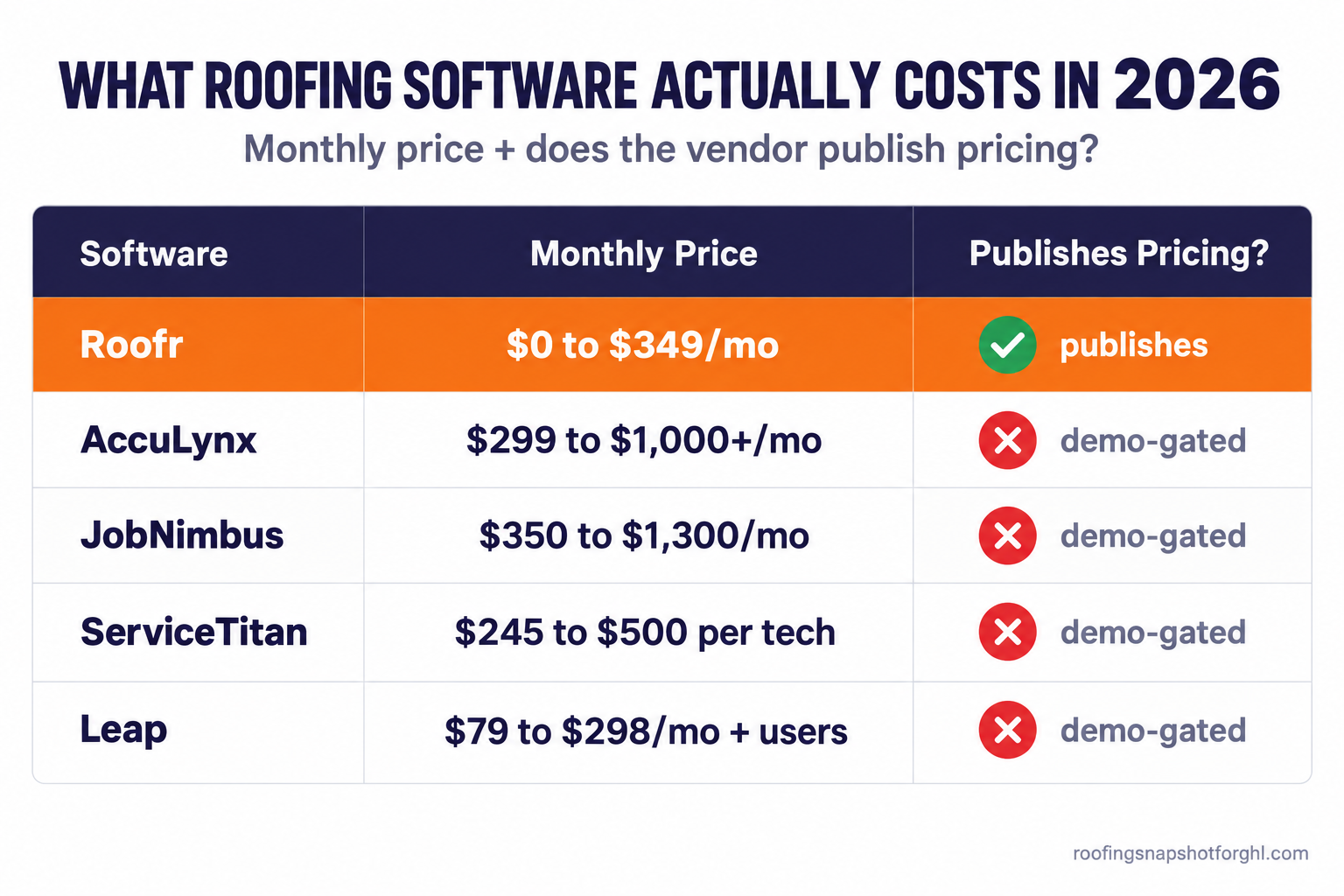
Here is the short answer. For a roofing company running one to five crews, real all-in software cost in 2026 lands between about $200 a month (Roofr, the only vendor that publishes its full price) and well past $1,500 a month once per-seat fees, texting add-ons, and implementation charges stack up on AccuLynx, JobNimbus, or ServiceTitan. One roofer on r/Roofing reported paying “about 5k per month with all our add-ons” for AccuLynx. This post prices every major vendor, exposes the tricks that make the sticker meaningless, and hands you the questions to force the real number out of a demo.
Key Takeaways
- Only Roofr publishes full pricing: free Starter, $249/mo Essentials ($209 annual), $349/mo Scale, no per-seat fees (Roofr, 2026).
- AccuLynx, JobNimbus, ServiceTitan and Leap gate pricing behind a demo. Reported numbers run from $299/mo to $1,000+/mo for a mid-size crew, higher with add-ons (Hook Agency, Projul).
- The sticker is never the bill. Per-user fees, texting ($49–$249/mo), implementation ($5,000–$50,000+ on ServiceTitan), and multi-year contracts are where the money goes (Projul).
- Per-seat pricing punishes hiring. A $70/user platform costs $140 for two people and $1,050 for fifteen. Flat pricing does not.
- You are probably overpaying for the lead and follow-up layer buried inside a $1,000/mo suite, when flat-cost automation handles speed-to-lead and follow-up for a fraction of that.
Table of contents
- Why roofing software pricing is built to confuse you
- The three pricing models, and why the model matters more than the number
- AccuLynx pricing in 2026
- JobNimbus pricing in 2026
- ServiceTitan pricing in 2026
- Roofr pricing in 2026
- Leap pricing in 2026
- The full comparison at a glance
- Three cost scenarios: solo, mid-size, and large
- The hidden costs nobody quotes you
- Steal this: the demo-call script that forces out the real price
- The part you are overpaying for
- Objections
- FAQ
Why roofing software pricing is built to confuse you
Roofing is a high-ticket trade, and vendors know it. A roof replacement averages about $9,602 nationally (HomeAdvisor, 2025). When one signed job clears five figures, a $1,000-a-month bill feels small, and vendors price accordingly. The demo gate is deliberate: if you cannot compare two prices side by side, the rep gets to anchor you on job value instead of monthly cost.
There is a second reason your bill balloons. You are almost never buying one tool. Most shops stitch together a CRM, a measurement tool, and a photo app, commonly Roofr for measurement, CompanyCam for photos, and JobNimbus for the CRM all at once (Jobber, 2026). Three logins, three bills, three renewal dates, and none of the vendors owns the total.
The three pricing models, and why the model matters more than the number
Before any single price means anything, know which of three models a vendor uses. The model, not the headline number, decides your bill as you grow.
Per-user (per-seat). You pay for every person who logs in. AccuLynx and Leap work this way. It looks cheap at two seats and turns brutal at fifteen. Every hire raises the bill, so the model quietly taxes the growth a storm-season shop needs to do fast.
Per-technician. ServiceTitan charges by the field tech, the same trap with a roofing label. More crews on the roof means a bigger invoice, on top of an implementation fee that can dwarf a year of subscription.
Flat (base plan). You pay a set price and add people with no per-head charge, or with a generous seat count included. Roofr runs this way. JobNimbus is a hybrid, a flat base plus per-user fees, so it starts flat and drifts toward per-seat as you scale. A per-seat and a flat platform can quote the same number today and bill you wildly differently in eighteen months. Price the model against the shop you are building, not the shop you have.
AccuLynx pricing in 2026
AccuLynx is the category’s most established production CRM, and its most opaque. It does not publish full pricing. The only public entry point is an Essential plan that starts around $250/month; everything past that requires a sales call (Roofing Software Guide, 2026).
Underneath, AccuLynx runs a per-user model: roughly $55/user/month for Essentials, $70/user for Professional, and $85/user for Elite, so a small team starts near $299/month and a mid-size crew commonly runs $1,000 or more (Hook Agency, 2025). The sticker is only the base. Texting, SmartDocs, the customer portal, and integrations stack on top. That is how one roofer on r/Roofing (August 2025, a single user report, weigh it as one data point) landed at “about 5k per month with all our add-ons.”
How the bill breaks: you sign up for the base, then find the texting and customer portal you watched in the demo are extra, then hire two salespeople for storm season and your per-user line jumps overnight. The number you agreed to and the invoice six months later are rarely the same number.
Who it is right for: a larger, stable-headcount restoration shop that lives inside a full production suite all day and can absorb per-seat pricing. If you are five people who mostly need the phone answered fast, you are buying a battleship to cross a pond.
The wild card is ownership. Verisk agreed to buy AccuLynx for $2.35 billion in July 2025, tried to back out, and in August 2026 the Delaware Court of Chancery ordered it to close anyway (Bloomberg Law, 2026; Axios, 2026). A roofing CRM owned by an insurance-data giant that also sells claims data to carriers is a change worth watching before you sign a long contract.
JobNimbus pricing in 2026
JobNimbus is AccuLynx’s closest rival and also demo-gated, though its structure is clearer. It uses a hybrid model: a flat base plus per-user fees. The Growing plan is about $225/month base and Established about $550/month base, with per-user fees of roughly $20 to $75/month on top by role, and texting packages from $49 to $249/month (Projul, 2026). All in, most shops land between $350 and $1,300/month. JobNimbus also owns SumoQuote, the proposal tool, which it will bundle in and nudge the total up again.
How the bill breaks: the base looks reasonable, so you say yes. Then the per-user fees and the texting package, the thing you needed the software for, push you toward the top of the range.
Who it is right for: a small-to-mid shop that wants a genuine production CRM with estimating and does not mind a bill that scales with headcount. Just run the full math on your real seat count and texting volume before you compare it to anything.
ServiceTitan pricing in 2026
ServiceTitan is the enterprise option, built for large field-service operations and priced like it. Pricing is demo-gated and charged per technician: reported tiers run Starter around $245–$300/tech/month, Essentials $300–$400, and The Works $400–$500 (Projul, 2026; Costbench, 2026).
Then comes the part that makes roofers wince. Implementation fees run from $5,000 to $50,000 or more, add-on modules like Marketing Pro can add roughly $2,000/month on their own, and early-termination fees have shown up in BBB complaints as high as $39,375 (Projul, 2026). Contractors also report real difficulty exporting their own data after cancellation.
How the bill breaks: the per-tech rate is the appetizer. The five-figure implementation, the marketing module, and the multi-year commitment are the meal, and getting out is its own expense.
Who it is right for: a large, multi-location operation with the volume and back office to justify enterprise software. For a 1-to-5-crew roofing company, ServiceTitan is almost always more platform, and more lock-in, than the problem requires.
Roofr pricing in 2026
Roofr is the anchor of any honest roofing software comparison for one reason: it publishes everything. As of its March 2026 update, the tiers are Starter (free forever), Essentials at $249/month ($209 billed annually), and Scale at $349/month ($299 annual), and critically, there are no per-seat fees (Roofr, 2026). Scale includes ten seats. Measurement reports are billed separately at $19 each on the free plan and $13 on paid plans. You can price your first year on Roofr’s website in ninety seconds, which is more than you can say for any other name on this list.
How the bill breaks: the one variable is per-report fees. Order a lot of reports and budget for the $13-each line; otherwise the monthly number is the number.
Who it is right for: shops that value predictable pricing and lead with measurement-to-proposal speed. Roofr leans toward estimating and sales proposals rather than deep insurance-supplement production, so match it to how your revenue flows. It is the number every other vendor should have to beat out loud.
Leap pricing in 2026
Leap (formerly JobProgress, now majority-owned by Nexa Equity, which merged the two platforms) is a respected roofing and remodeling CRM. Pricing is demo-gated, with reported rates of Essential around $79/month and Team around $298/month, plus additional users at roughly $99/user/month, and an enterprise tier above that (Roofing Software Guide, 2026).
The catch is the contract. Both plans reportedly require a one-year commitment with monthly billing and a 60-day written cancellation notice, which several reviewers say meant being billed for months after they asked to leave.
How the bill breaks: the $79 entry looks great until you add users at $99 each, and the annual contract plus 60-day notice means a bad fit costs far more than one month to escape.
Who it is right for: remodeling-adjacent contractors who value Leap’s proposal and financing tools and can commit for a year. Read the cancellation clause before you sign, not after.
The full comparison at a glance
| Vendor | Publishes pricing? | Entry price | Real all-in (small shop) | Model | Where the bill hides |
|---|---|---|---|---|---|
| Roofr | Yes, in full | $0 (Starter) | ~$209–$349/mo | Flat, no per-seat | $13–$19 per measurement report |
| AccuLynx | No (demo-gated) | ~$250/mo | ~$299 to $1,000+/mo | Per-user ($55–$85) | Texting, SmartDocs, portal add-ons |
| JobNimbus | No (demo-gated) | ~$225/mo base | ~$350–$1,300/mo | Base + per-user | Per-user + texting ($49–$249/mo) |
| ServiceTitan | No (demo-gated) | ~$245/tech/mo | $1,000s/mo + setup | Per-technician | Implementation $5k–$50k+, ETF, export |
| Leap | No (demo-gated) | ~$79/mo | ~$298 + $99/user/mo | Base + per-user | 1-yr contract, 60-day cancel notice |
Three cost scenarios: solo, mid-size, and large
The right answer changes with your size, because the models bend in different directions.
Solo operator (1 crew, 2 seats)
At two seats, per-user pricing is at its friendliest. AccuLynx Essentials runs roughly $110/month for two users before add-ons; Leap Essential starts near $79; Roofr Starter is free and Essentials is $209 annually, flat. Raw cost is close, so decide on fit and lock-in, not price. Your real risk is a one-year contract with a 60-day cancellation clause, not the monthly number.
Mid-size shop (3 crews, ~8 seats)
This is where the models split hard. A per-seat platform at ~$70/user is now $560/month in seat fees alone before add-ons, which is how AccuLynx lands near $900 all-in. JobNimbus sits around $700 with per-user and texting. ServiceTitan, charging per tech and amortizing a five-figure implementation, is comfortably past $1,000. Roofr, still flat, is roughly $209. The gap between flat and per-seat is real money here, $500 to $1,300 a month, every month.
Large operation (5+ crews, 15+ seats)
At fifteen seats, per-seat pricing is a tax on headcount: a $70/user platform is over $1,000/month in seats alone, and ServiceTitan runs into the thousands. This is the only tier where the expensive suites start to earn their price, because you use the deep production, dispatch, and reporting features every day. Below it, you are mostly paying for seats you fill and features you never open.
The hidden costs nobody quotes you
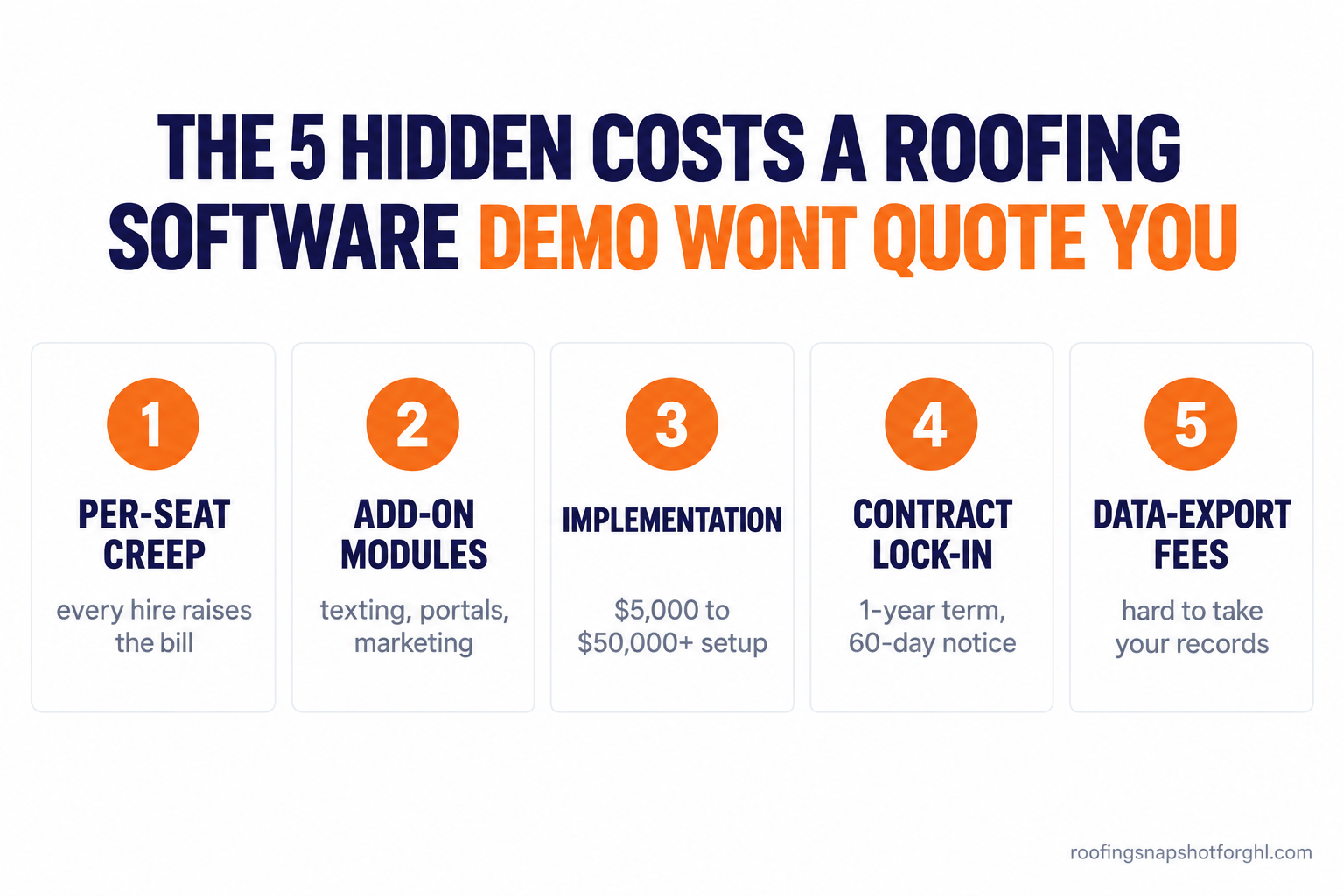
The monthly number is the smallest part, which is why vendors point at it. The real cost lives in five line items that rarely make the demo:
- Per-seat creep. Every hire raises the bill, and storm season is when you add people fastest, so your software cost spikes when cash is tightest. Flat pricing does not do this.
- Add-on modules. Texting, customer portals, document tools, marketing suites. The feature you are buying the software for is often the add-on, not the base plan.
- Implementation. ServiceTitan’s $5,000-to-$50,000-plus setup is the extreme, but most enterprise tools charge to get you live, and the quote you sign rarely includes it.
- Contract and cancellation. A one-year commitment with a 60-day notice clause can mean paying for months after you stop using the tool. Read the exit before you sign the entry.
- Data-export lock-in. If leaving means you cannot easily take your own customer records with you, the switching cost is a hidden line on every renewal. Contractors report exactly this with the biggest suites.
Steal this: the demo-call script that forces out the real price
Since four of these five vendors will not publish a price, you have to extract it. Do not let a rep run the call. Run it with this checklist, and do not book a second call until you have answers in writing.
Email first: “Before we schedule, send the base monthly price for my plan, the per-user or per-tech fee, and a one-line list of what costs extra. I am comparing three vendors on total cost. If you cannot share pricing before a call, tell me now.”
On the call, ask each of these and write down the answer:
- What is the base monthly price, and how many seats does it include?
- What is the per-user or per-technician fee for every seat beyond that?
- Which features shown today are add-ons, and what does each cost? (Name texting, customer portal, document tools, and any marketing module.)
- Is there an implementation or setup fee? What dollar amount?
- What is the contract length, and the exact cancellation process and notice period?
- If I leave, how do I export my customer and job data, and is there a fee?
- Put the all-in monthly total for my headcount in writing before I sign.
The math that ends the call: take the all-in monthly total, multiply by your peak-season headcount, add one-twelfth of any setup fee, and compare that single number across vendors. If a rep will not give you the numbers to build it, that refusal is the answer, and Roofr’s published pricing is your baseline.
The part you are overpaying for
Here is the question almost no roofer asks: which part of this expensive software am I actually using every day? Rarely the deep production module. For most 1-to-5-crew shops the daily pain is upstream of it: the storm lead that goes cold because nobody texted back while the crew was on a roof, the estimate that never got a follow-up, the review that never got asked for. The speed-to-lead and follow-up layer is where jobs are won and lost, and it is a thin slice of what a $1,000-a-month production suite does.
That layer does not need a per-seat production CRM. It needs automation: an instant SMS the second a lead hits any channel, a follow-up cadence that fires without anyone remembering, a review request the day after tear-off, and a pipeline that never lets a claim stall between inspection and deposit. Responding in the first few minutes instead of the first few hours is the single highest-return fix in roofing (see our roofing lead response time piece and the full cost-per-lead breakdown), and it costs a fraction of a per-seat suite to automate.
That is the premise of building this layer on GoHighLevel instead of renting it inside a per-seat platform. A flat-cost SMS and follow-up automation system works every lead you already pay for, with no per-user fee punishing you for hiring in storm season. If you also need heavy insurance-supplement production, keep that tool and stop paying it to be your marketing engine too.
Objections
“I already pay for AccuLynx (or JobNimbus). Isn’t this redundant?” Not usually. If your production CRM is where you run supplements, dispatch, and job tracking, keep it. What most shops are missing is not more production software, it is the automated lead-response and follow-up layer that turns paid leads into booked inspections. That layer sits in front of your CRM, not on top of it.
“Isn’t cheaper software just worse software?” Cheaper is not the point; transparent and flat-priced is. Roofr proves a roofing tool can publish its full price and still be good. A per-seat platform is not “better” because it costs more, it costs more because it charges per head. Paying for seats you fill and modules you never open is not quality, it is waste.
“Do I need to be technical to run an automation system?” No. A done-for-you setup ships with the pipeline, message templates, and follow-up cadences already built and wired. If you can send a text and read a pipeline, you can run it, which beats a five-figure implementation that needs a dedicated admin.
“Should I wait on the Verisk and AccuLynx deal?” Do not freeze, but do not sign a long, hard-to-cancel AccuLynx contract without eyes open. The Delaware court ordered the $2.35 billion acquisition to proceed (Bloomberg Law, 2026), so ownership and incentives are changing. Keep your data portable and your contract short until the dust settles.
The bottom line on roofing software cost in 2026
Pricing opacity is the tell. Only Roofr publishes its full price; the rest hide the number behind a demo, and the real bill lands from $299 to well over $1,500 a month once seats, add-ons, and implementation stack up. Do not chase the cheapest tool. Know which pricing model you are signing, run the all-in math on your peak headcount, and be honest about which layer you use every day. For most 1-to-5-crew shops the expensive part is not the part that wins jobs. Speed-to-lead and follow-up win jobs, and that runs on flat-cost automation, not a per-seat suite. Buy the production tool if you truly work it, and stop overpaying it to do the one job automation does better and cheaper.
Frequently asked questions about roofing software cost
How much does roofing software cost per month in 2026?
Roofr publishes its full pricing: free Starter, $249/mo Essentials ($209 annual), $349/mo Scale, no per-seat fees (Roofr, 2026). AccuLynx, JobNimbus, ServiceTitan and Leap gate pricing behind a demo, and real-world numbers run from about $299/mo to $1,000+/mo for a mid-size crew once per-user fees and add-ons stack up.
Why won't roofing software companies show their prices?
Roofing is a high-ticket trade (a roof averages ~$9,602, per HomeAdvisor), so vendors anchor you on job value instead of monthly cost, and a demo gate stops you shopping two prices side by side. Roofr is the exception that publishes everything.
How much does AccuLynx actually cost?
AccuLynx does not publish full pricing. The public entry is an Essential plan around $250/month, on a per-user model of roughly $55–$85/user/month with texting, SmartDocs and portal add-ons on top (Hook Agency, 2025). Small teams start near $299/mo; mid-size crews commonly pay $1,000+/mo, and one r/Roofing user reported about $5,000/month with all add-ons.
What is the cheapest roofing CRM?
Roofr's Starter plan is free forever (you pay $19 per measurement report). Among paid plans, Leap Essential reportedly starts around $79/month and Roofr Essentials is $209 annually. But 'cheapest' depends on seat count: a low per-user base passes a flat plan quickly as you add people, so price the model against your peak headcount, not the sticker.
Does the Verisk acquisition change whether I should buy AccuLynx?
Verisk agreed to buy AccuLynx for $2.35 billion, and in August 2026 the Delaware Court of Chancery ordered the deal to proceed (Bloomberg Law, 2026). Ownership incentives are shifting, so keep your data portable and avoid long, hard-to-cancel contracts until it settles.
Do I need an expensive production CRM to run a small roofing company?
Usually not. Deep production and dispatch suites earn their price at 15+ seats. For a 1-to-5-crew shop the daily pain is speed-to-lead and follow-up, which runs on flat-cost automation for a fraction of a per-seat suite. Match the tool to the job you do every day.
About the author
Dale Rourke spent eleven years running crews and the sales board for a storm-restoration outfit in Tornado Alley before moving full-time into GoHighLevel automation. He has lived the 2 a.m. hail-event scramble, signed the software contracts, and paid the per-seat bills. He writes about speed-to-lead, storm-chase capture, and the workflows that decide who signs the roof first.
Related posts
- How Much Does a Roofing Lead Cost in 2026? Cost Per Lead by Channel
- Roofing Lead Response Time: The 5-Minute Rule That Decides Who Signs
- How to Migrate a Roofing Business to GoHighLevel
- Roofing Sales Pipeline: The 7 Stages From Storm Lead to Signed Deposit
- Roofing Snapshot vs. Building GoHighLevel Yourself