
It is a Tuesday in March and you finally take the ServiceTitan demo you have been putting off. The rep is sharp. The dispatch board looks incredible. Then you ask the only question that matters: “What does this cost for a shop my size?” The answer is a 45-minute follow-up call, a multi-year contract, and a per-tech price that would eat a whole crew’s margin. You run 1-5 crews. You are not the customer ServiceTitan was built for, and the price tag tells you that before the contract does.
Here is the short version: if you run a small or mid-size roofing company, ServiceTitan is almost never the right tool. It was built for large, multi-trade home-services operations, it hides its pricing behind a demo, and its contracts lock you in for a year or more with early-termination fees that show up in Better Business Bureau complaints as five-figure numbers. Five alternatives are cheaper, roofing-first, and far easier to leave if they flop. This guide compares them on real 2026 pricing, contract terms, roofing fit, and the thing that actually wins storm jobs: how fast you follow up.
Table of contents
- Why ServiceTitan is the wrong fit for most roofers
- What ServiceTitan actually costs (and why you can’t see it)
- The 8 things that actually matter when you switch
- The 5 alternatives, compared
- Steal this: the 6 questions to ask on any demo call
- Which one is right for your shop? Three scenarios
- One legal thing before you automate your follow-up
- Objections, answered honestly
- FAQ
Why ServiceTitan is the wrong fit for most roofers
ServiceTitan is good software. That is not the argument. The argument is that it was built for a different company than yours.
ServiceTitan is positioned for large and enterprise home-services operations, primarily HVAC, plumbing, and electrical companies with big dispatch teams and heavy call volume. Independent reviewers put its per-technician pricing in the range of roughly $250 to $398 per user per month, and that is before implementation, add-on modules, and the payments cut (Contractor ToolStack, SoftwareAdvice). For a shop running one to five crews, that math does not work. You are paying for a dispatch-heavy, multi-trade platform and using a fraction of it.
The tell is the demo wall. You cannot see a price on ServiceTitan’s website. You book a call, you sit through a pitch, and you get a custom quote that depends on how many seats you need and which modules you buy. That is standard enterprise sales. It is also a signal that the number is high enough that they would rather explain it to you in person.
Roofers who tried it and left say the same thing. One contractor on Reddit’s r/sweatystartup reported switching off a short ServiceTitan trial back to a cheaper tool, saying he was billed roughly $4,200 a month for work a $329 product did just as well, and that “the dispatch board was prettier, that was the only real difference” (reported via Roofing Software Guide; a single user report, so weigh it as one). You do not have to take one Reddit post as gospel. You do have to notice that nobody running a small shop recommends it on price.
What ServiceTitan actually costs (and why you can’t see it)
The subscription is only the first line item. The part that traps small contractors is the contract.
ServiceTitan contracts run a minimum of 12 months and are frequently pushed to two or three years for a “discounted” rate. Cancelling early does not mean forfeiting a deposit. It means paying the full remaining value of the contract. Better Business Bureau complaints document early-termination charges of $24,000, $39,375, $40,000, and $46,170, including one contractor who tried to cancel after 10 days because implementation failed and was handed a $39,375 buyout (ProJul’s ServiceTitan pricing breakdown summarizing BBB filings). The contracts also auto-renew, with a cancellation window that often closes 60 to 90 days before the renewal date. Miss it and you are locked in for another full term.
Early-termination fees documented in ServiceTitan Better Business Bureau complaints (USD). Cancelling early means paying the remaining contract value. Source: ProJul, summarizing BBB filings.
That is the real risk for a small roofer. Not that the monthly price is high, though it is. The risk is that if you sign, discover it is overkill in month two, and try to leave, the exit costs more than a used dump trailer. Every alternative below is easier and cheaper to walk away from.
The 8 things that actually matter when you switch
Do not compare roofing software on feature-count. Every platform has 300 features and you will use 20. Compare on the things that decide whether the tool pays for itself:
- Price transparency. Can you see the price without a sales call? Hidden pricing means the number moves based on what they think you will pay.
- Contract length and exit terms. Month-to-month or annual, and what does cancelling cost? This is where small shops get burned.
- Roofing-first or general. Roofing-specific means aerial measurements, supplement tracking, and material orders are native, not bolted on.
- Measurement and estimating. Does it do aerial measurements and proposals in-house, or do you pay for a separate tool like EagleView or Hover on top?
- Insurance and supplement workflow. Can you track a job from inspection to RCV to supplement to deposit inside the tool?
- Speed-to-lead and follow-up automation. When a storm lead comes in at 9pm, does the software text them back in seconds, or just store their name? This is the one that makes you money.
- Migration cost and time. How hard is it to get your data in, and how long until you are live?
- Who it is actually right for. Honest fit, not marketing fit.
One warning before the comparison, because it wrecks credibility with roofers: EagleView, Hover, RoofSnap, and CompanyCam are not CRMs. They are measurement and photo tools. They do not run your pipeline, follow-up, or claims. If a comparison tells you to “replace AccuLynx with Hover,” close the tab. They solve different problems, and you may end up paying for both.
The 5 alternatives, compared
Here is the honest picture across the five real ServiceTitan alternatives a roofer actually shops. Pricing is current for 2026 and sourced below the table.
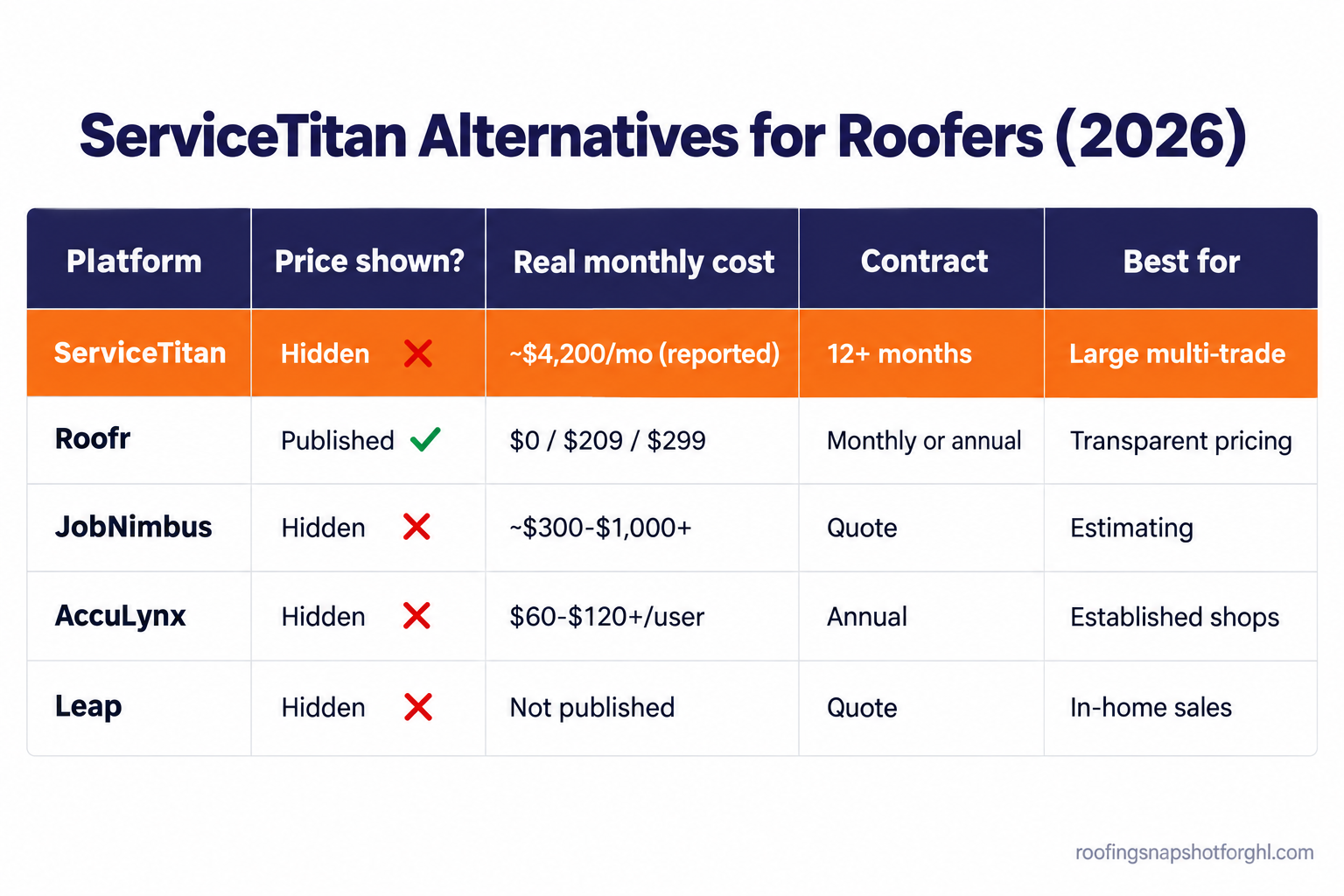
| Platform | Pricing visible? | Real 2026 price | Contract | Roofing-first? | Best for |
|---|---|---|---|---|---|
| Roofr | Yes, fully published | Free Starter, $209/mo (Essentials, annual), $299/mo (Scale, annual); unlimited users | Monthly or annual | Yes | Shops that want transparent, per-report pricing |
| JobNimbus | No, quote only | Reported ~$300-$1,000+/mo, tiered by user count | Quote-based | Yes | Teams wanting estimating via SumoQuote |
| AccuLynx | No, demo only | Reported ~$60-$120+/user/mo plus add-ons | Annual | Yes | Established shops already deep in the ecosystem |
| Leap | No, quote only | Not published | Quote-based | Yes | Shops wanting door-to-close sales flow |
| A GoHighLevel build | Depends on setup | Platform from $97/mo; system pre-built | Month-to-month | Configurable | Storm shops that live on speed-to-lead |
Sources: Roofr pricing (Capterra), SoftwareAdvice; JobNimbus and AccuLynx figures are third-party reported ranges (JobNimbus on Capterra). Verify each vendor’s current quote directly.
Roofr: the one that shows you the price
Roofr is the transparency anchor for this whole category, because it publishes everything. There is a free-forever Starter plan (you pay $19 per aerial report, no monthly fee), an Essentials plan at $249 a month or $209 billed annually, and a Scale plan at $349 a month or $299 billed annually, with reports at $13 each on the paid tiers (Capterra). Every plan includes unlimited users, so hiring a third estimator does not raise your bill.
Where it fits: measurement, proposals, invoicing, and job pipeline in one place, priced so you can do the math yourself. How it breaks: its automation and multi-channel follow-up are lighter than a purpose-built CRM. If your edge is speed-to-lead across SMS, web, and Facebook, Roofr alone will not run that.
JobNimbus: roofing-first, price hidden
JobNimbus is a genuine roofing and contractor CRM with a real following. It hides its pricing behind a sales call, quoting by tier (Essentials up to 3 users, Pro up to 10, and so on), with third-party reports putting real budgets around $300 to $1,000-plus a month depending on seats (Capterra). In January 2024 it acquired SumoQuote, a strong estimating and proposal tool, which it now bundles (BetaKit).
Where it fits: shops that want solid estimating and a roofing-shaped pipeline. How it breaks: the per-user model means costs creep as you grow, and you cannot compare it on price without a call.
AccuLynx: strong, established, and mid-ownership-change
AccuLynx is one of the most established end-to-end roofing platforms, and it is also the one to think hardest about right now. Its pricing is demo-gated, with third-party reports around $60 to $120-plus per user per month plus paid add-ons for things like texting, aerial measurements, and the customer portal.
The bigger story is ownership. Verisk signed a definitive agreement to buy AccuLynx for $2.35 billion in July 2025 (Insurance Journal). Verisk then tried to terminate the deal, AccuLynx sued, and on August 7, 2026 the Delaware Court of Chancery ruled the termination invalid and ordered specific performance, forcing Verisk to keep pursuing the merger while antitrust clearance is still pending (Bloomberg Law). Verisk is an insurance-data company. If that deal closes, the tool your roofing business runs on will be owned by a firm whose core customers are insurers. Not automatically bad, but a fact to weigh before signing a multi-year deal.
Where it fits: established shops already deep in AccuLynx that value its maturity. How it breaks: opaque per-user pricing, add-ons that stack, and an owner about to change.
Leap: sales-flow focused, also quote-only
Leap is built around the door-to-close sales process: digital estimates, contracts, and financing at the kitchen table. It is majority-owned by Nexa Equity and acquired JobProgress in March 2022 to broaden its platform (PRNewswire). Pricing is not published; you request a quote.
Where it fits: shops whose bottleneck is the in-home sales presentation and financing. How it breaks: same hidden pricing, and it is more sales-tool than full operations CRM.
A GoHighLevel-based system: built around speed-to-lead
The fifth option is different in kind. Instead of a fixed product, it is a configurable platform, GoHighLevel, set up as a roofing system. The platform starts around $97 a month, month-to-month, and the value is in how it is built: automatic missed-call text-back, storm-lead capture, speed-to-lead SMS in seconds, insurance-claim pipeline stages, and follow-up across SMS, web, and Facebook in one account.
Where it fits: storm-driven shops whose edge is being first to respond, and anyone tired of paying for a CRM plus a measurement tool plus a photo app and stitching them together. How it breaks: raw GoHighLevel is a blank account. Built from scratch it can take months, which is exactly the problem a pre-configured roofing system solves.
Steal this: the 6 questions to ask on any demo call
When a vendor hides its price, you take the power back by controlling the questions. Copy these into your notes and ask every one before you agree to anything.
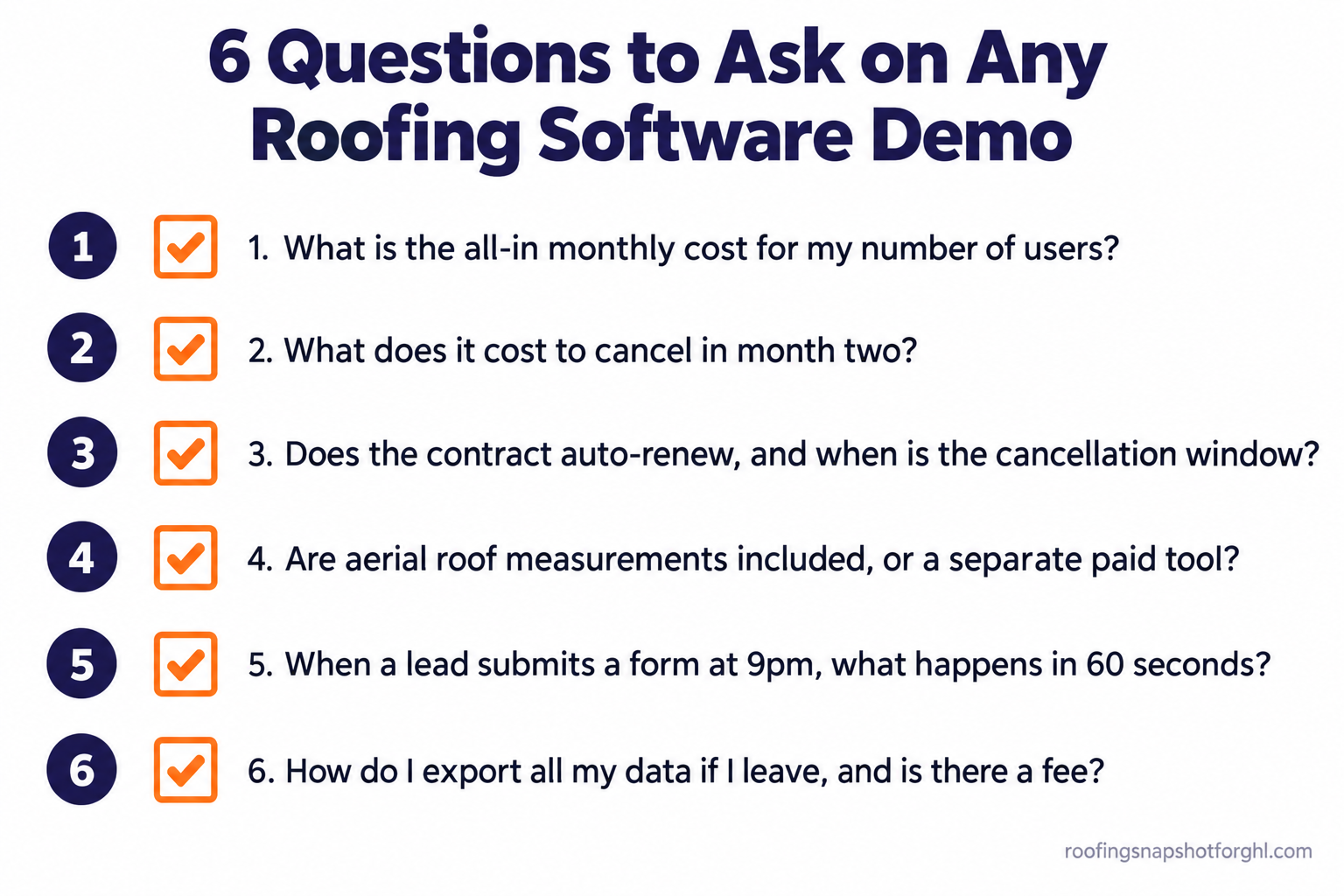
And here is the speed-to-lead text every one of these tools should be able to fire automatically the second a storm lead comes in. Steal it:
“Hi [First Name], this is [Your Name] with [Company]. Thanks for reaching out about your roof after the storm. I can have someone out to take a look at no cost. Are mornings or afternoons better for you this week? Reply STOP to opt out.”
Short, human, gives two choices, includes the opt-out. If your software cannot send that within a minute of the form hitting, it is failing at the one job that decides who signs the roof. For the deeper version of this, see our guide on why a 30-second response wins storm jobs.
Which one is right for your shop? Three scenarios
The honest answer to “what should I use instead of ServiceTitan” is that it depends on your size. Here is the framework run three ways.
The solo operator or 1-crew shop
You are the salesperson, the estimator, and half the time the guy on the roof. Your problem is not features. It is that leads go cold while your hands are full. You cannot afford per-user pricing when there is basically one user, or a multi-year contract on a business this lean.
Pick: Roofr’s free Starter tier gets you measurements and proposals for $19 a report with zero monthly commitment, unbeatable when volume is low. But if your leads are storm-driven, a lightweight GoHighLevel setup that texts every lead back instantly will make you more money than any measurement tool, because at your size one lost job is a big chunk of the month. Do not buy AccuLynx or ServiceTitan. You will use 10% of them.
The 2-3 crew, growing shop
You have an office person now, maybe a dedicated salesperson, and real storm volume. Now follow-up cadence, claims tracking, and not dropping leads across channels is where money leaks. Per-user pricing starts to bite, and hidden-price tools make budgeting hard.
Pick: this is the sweet spot for either Roofr’s Scale plan (unlimited users, so your growing team does not raise the bill) or a full roofing operations build that runs speed-to-lead, an inspection-to-deposit claims pipeline, and multi-channel follow-up in one account. JobNimbus is a fair third option if estimating via SumoQuote is your priority, but make them give you the all-in number first.
The larger storm-restoration operation
Multiple crews, supplement coordinators, a real sales team, hundreds of leads in a storm week. You have the volume to justify a heavier platform, and integration across measurement, claims, and production matters more than saving a few hundred dollars a month.
Pick: this is the only tier where AccuLynx or JobNimbus genuinely earn consideration, because their maturity and depth pay off at scale. Even here, weigh the AccuLynx ownership change and get the exit terms in writing. And do not assume “bigger” means ServiceTitan. Plenty of large roofing-only shops run leaner, roofing-first stacks and route the saved money into supplement recovery and follow-up instead of software fees.
Published monthly cost, USD. Roofr tiers are annual-billing prices from Roofr’s published pricing; the ServiceTitan figure is one roofer’s reported monthly bill (a single r/sweatystartup user report). Sources: Roofr (Capterra), Roofing Software Guide.
One legal thing before you automate your follow-up
Whichever tool you land on, the automation is only worth having if it is legal. Two rules matter for roofers.
First, texting. To fire automated SMS to storm leads you need consent and you need to register for A2P 10DLC, the carrier program that governs business texting in the U.S. Skip it and your messages get filtered or blocked, which quietly kills your speed-to-lead the moment you need it most. Our A2P 10DLC registration guide walks through the setup.
Second, claims language. Several states, including Florida under SB 76 and Wisconsin under 2013 Act 24, bar contractors from negotiating insurance claims for the homeowner or offering to absorb deductibles. So the “we handle your insurance claim for you” copy a lot of roofing sites run can be illegal where you operate. Your CRM does not know that, so your templates need to. We break down what roofers can and can’t legally say about insurance claims state by state. Build your automated messages compliant from day one, not after a complaint.
Objections, answered honestly
“I already pay for ServiceTitan. Am I stupid for staying?” No. If you are a large multi-trade operation using its dispatch and reporting heavily, it can be the right call. The question is whether you are actually using it. Pull your last three months of usage. If your crews touch a fraction of the modules and you are a roofing-only shop under five crews, you are subsidizing features you do not run. Check your renewal date and cancellation window now, because that window is the only real bargaining power you have left.
“Isn’t cheaper software just worse software?” Not in this category. Roofr publishes its price because it is confident in the value, not because it is a discount product. The expensive-and-hidden tools are not hiding a better product, they are hiding a bigger number. For a small shop, “worse” is paying enterprise money for features you never open. Right-sized beats maxed-out at your scale.
“Do I need to be technical to switch?” For Roofr, no. It is close to plug-and-play. For a GoHighLevel-based system, raw setup is technical, the honest downside of the platform. That is why pre-built roofing systems exist: someone else does the wiring so you get a working, roofing-shaped account without learning the platform from zero. If you would rather not touch the plumbing, that is a setup choice, not a reason to stay on ServiceTitan.
“What happens to my data when I switch?” This is the question that separates good vendors from lock-in traps, which is why it is on the demo-call script above. Any tool worth using lets you export your contacts, jobs, and history without a fee. Before you migrate anything, get your export confirmed in writing. If a vendor is cagey about letting your data leave, that tells you how the relationship ends. And run the switch in your slow season, not the week 200 storm leads come in, so your pipeline and follow-up are tested before the next hail cycle.
You do not need the most powerful roofing software on the market. You need the one that fits a shop your size, that you can leave if it does not work, and that texts your storm leads back before the out-of-state door-knocker reaches the porch. Take the demo if you want. Ask the six questions. Then pick the tool that answers them straight.
FAQ
ServiceTitan alternatives for roofers: common questions
What is the best ServiceTitan alternative for a small roofing company?
For most 1-5 crew roofing shops, Roofr is the strongest starting point because it publishes its pricing (a free Starter plan, then $209/mo Essentials or $299/mo Scale billed annually with unlimited users) and has no long lock-in. If your edge is speed-to-lead on storm work, a GoHighLevel-based roofing system that texts leads back in seconds often makes more money than any measurement-first tool.
How much does ServiceTitan cost for roofers?
ServiceTitan does not publish pricing; you must take a demo for a quote. Third-party reviewers estimate roughly $250 to $398 per user per month before add-ons, and one roofer reported a bill around $4,200 a month. Contracts run 12 months or longer, and early cancellation means paying the remaining contract value, with BBB complaints documenting fees from $24,000 to $46,170.
Is Roofr cheaper than ServiceTitan?
Yes, substantially. Roofr's paid plans run $209 to $349 a month with unlimited users, versus ServiceTitan's per-user enterprise pricing that reportedly reaches thousands per month for a small shop. Roofr also has no multi-year lock-in, so it is far less risky to try.
Are EagleView, Hover, or CompanyCam alternatives to ServiceTitan?
No. EagleView and Hover are aerial measurement tools and CompanyCam is a jobsite photo app. They are useful, but they are not CRMs and do not run your pipeline, follow-up, or claims. Treat them as add-ons to a CRM, not replacements for one, or you may end up paying for both.
Should I worry about the Verisk acquisition of AccuLynx?
It is worth weighing. Verisk agreed to buy AccuLynx for $2.35 billion in July 2025, tried to terminate, and a Delaware court ordered the deal to proceed in August 2026 with antitrust clearance still pending. If it closes, AccuLynx will be owned by an insurance-data company. That is a real consideration before signing a multi-year AccuLynx contract.
Can I switch roofing CRMs without losing my data?
Yes, if you plan it. Any reputable platform lets you export contacts, jobs, and history. Confirm the export terms in writing before you migrate, and run the switch during your slow season rather than mid-storm so your pipeline and automated follow-up are tested before the next hail cycle.