
The tear-off is done, the new roof is on, and the file sits in your “waiting on insurance” pile with a check that does not cover what you spent. The adjuster missed the drip edge, cut the ice-and-water barrier, priced the decking at last spring’s number, and left off overhead and profit. You are out a few thousand dollars on a job you already finished. That gap is a supplement, and most small shops leave it on the table because chasing it feels like a second job.
Here is the short answer. You get supplements approved faster by documenting the roof before a shingle moves, writing your estimate in the adjuster’s own line-item language, submitting a clean packet with a photo tied to every added line, then working a scheduled adjuster follow-up instead of hoping the phone rings. The shops that recover the most are not better negotiators. They are better at documentation and follow-up, and both are things a system does for you. This guide is that system, stage by stage, with the copy you can steal and the one legal line you cannot cross.
Key Takeaways
- A supplement is you being paid for real, documented work, not you negotiating the homeowner’s claim. You may document, estimate, submit with consent, and discuss scope. You may not “handle the claim” or waive the deductible (2013 Wisconsin Act 24).
- Documentation wins supplements, not argument. Every added line needs a dated photo and a reason. Supplements filed with a detailed contractor estimate typically recover 20 to 30 percent above the carrier’s first offer (IA Solutions).
- Speak Xactimate. Adjusters price in Xactimate, and its regional price lists refresh monthly. Matching line items and current pricing get approved far faster than a handwritten invoice.
- Follow-up is the whole game. A supplement dies in an adjuster’s inbox, not in a denial. A scheduled cadence of documented touches is what moves it, and that is exactly what a CRM automates.
- Steal the copy below. The homeowner authorization, the submission email, and the follow-up sequence are written out verbatim, plus how to run the system solo or with five crews.
Table of contents
- Why supplements are where your money leaks out
- The legal line you cannot cross
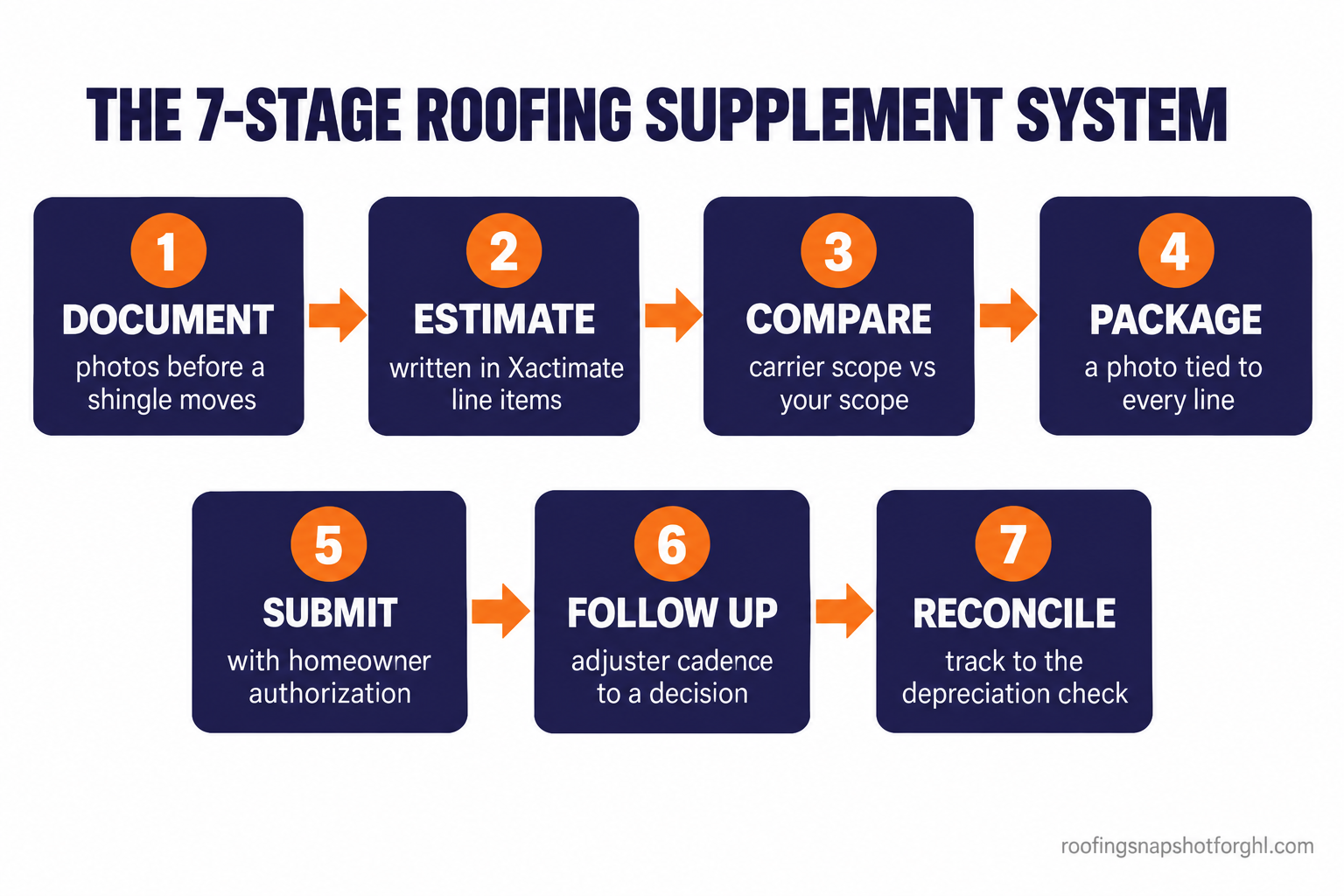
- The 7-stage supplement system at a glance
- Stage 1: Document before a shingle moves
- Stage 2: Write your estimate in the adjuster’s language
- Stage 3: Compare the carrier scope to yours, line by line
- Stage 4: Build the evidence packet
- Stage 5: Submit with the homeowner’s authorization
- Stage 6: Work the adjuster follow-up cadence
- Stage 7: Track approval to the depreciation check
- Steal this: the supplement follow-up copy
- Run it for a solo, a mid-size, and a large shop
- Objections
- FAQ
Why supplements are where your money leaks out
Storm work is not slowing down. The United States logged 5,432 large-hail reports in 2025, up from 5,373 in 2024 (Insurance Information Institute, citing NOAA’s Storm Prediction Center). Every one of those events turns into claims, and every claim starts with a carrier estimate that is almost never complete. The average full roof replacement now runs about $9,608 nationally, and past $46,000 on bigger or steeper homes (Angi). When the first check is 20 percent light, that is real money walking out the door.
Large-hail reports in the US, 2024 vs 2025. More storms mean more claims, and every claim is a supplement you either capture or lose. Source: Insurance Information Institute citing NOAA Storm Prediction Center.
The gap is not the adjuster being difficult. A field adjuster moves fast across dozens of roofs, works off a satellite measurement, and prices from the standard Xactimate list. Things get missed: the second layer of ice-and-water shield, the drip edge, the step flashing, the decking only visible after tear-off, the code upgrades your city requires. Add overhead and profit and the shortfall stacks up. Estimators put the typical recovery on a well-documented supplement at 20 to 30 percent above the first offer (IA Solutions). Most shops leave it because supplementing takes documentation they did not collect and follow-up they have no time for. Fix those two and the money is sitting right there.
The legal line you cannot cross
Get this straight before you build anything, because the fast way to a fine is to design your supplement workflow like a public adjuster’s. You are a contractor. You sell and build roofs. You do not adjust the homeowner’s claim.
You can inspect and document the damage, prepare a detailed estimate, submit it with the homeowner’s written permission, and discuss the scope of your work with the adjuster. Wisconsin, one of the strictest states, spells this out: a residential contractor may, with the insured’s express consent, discuss the damage, provide an estimate, submit it, and discuss repair options (2013 Wisconsin Act 24). What you cannot do is represent the homeowner as their claims agent, negotiate the settlement, interpret their policy, or promise the claim will “cost them nothing.” That is licensed public adjusting, and doing it without a license is a crime in nearly every state (NAPIA). You also cannot waive or absorb the deductible; in Florida that is third-degree felony insurance fraud (Fla. Stat. 489.147).
The 7-stage supplement system at a glance
A supplement is not one action. It is a pipeline that stalls at whichever stage you skip: document, estimate, compare, package, submit, follow up, reconcile. The follow-up stages are where a CRM earns its keep, which is why this maps onto a roofing sales pipeline with a claims track built in.
Stage 1: Document before a shingle moves
Setup. Every supportable line starts as a photo. Before the crew touches the roof, capture each slope, hail hits and wind creasing circled and dated, existing flashing and ventilation, layer count at a cut edge, decking once exposed, and any code item like a missing kickout. Shoot the address placard so every image ties to the property. Do it again at tear-off, because once the old roof is in the dumpster the second-layer proof and the rotten decking are gone forever.
How it breaks. The crew tears off before anyone documents, and the biggest lines, the extra layer and the bad decking, have no proof. The fix is a hard rule: tear-off does not start until the photos are uploaded. When your photo tool and CRM are connected, the job cannot advance until that box is checked, so the rule enforces itself instead of relying on a busy foreman.
Stage 2: Write your estimate in the adjuster’s language
Setup. Adjusters price in Xactimate, and its regional lists refresh every month to match current local labor and material costs (Verisk). If your estimate is a one-page lump sum, the adjuster has nothing to match against and your supplement stalls. Write your scope as itemized lines that map to Xactimate categories: tear-off by layer, felt or synthetic, ice-and-water by the square foot, drip edge by the linear foot, flashing by type, decking by the sheet.
How it breaks. You price from last quarter’s numbers and the line gets rejected as “above market.” Because Xactimate refreshes monthly, stale pricing looks inflated even when it is fair. Pull current pricing for the loss ZIP before you submit. If you do not run Xactimate yourself, a per-file supplement service can convert your scope into a matching, current-priced estimate.
Stage 3: Compare the carrier scope to yours, line by line
Setup. When the carrier estimate arrives, put it next to yours and reconcile every line. Mark three things: lines you agree with, lines they missed, and lines where the quantity or price is short. The missed and short lines are your supplement. Common misses: the second layer, ice-and-water in valleys and eaves, drip edge, step and counter flashing, detach-and-reset for solar or satellite, code items, and overhead and profit. Do this within 48 hours of receiving the scope, while the adjuster still remembers the roof.
How it breaks. You eyeball the two estimates and catch the obvious misses but lose the small ones. Ten small missed lines add up to more than one big one. A saved comparison template, same order every time, catches all of them.
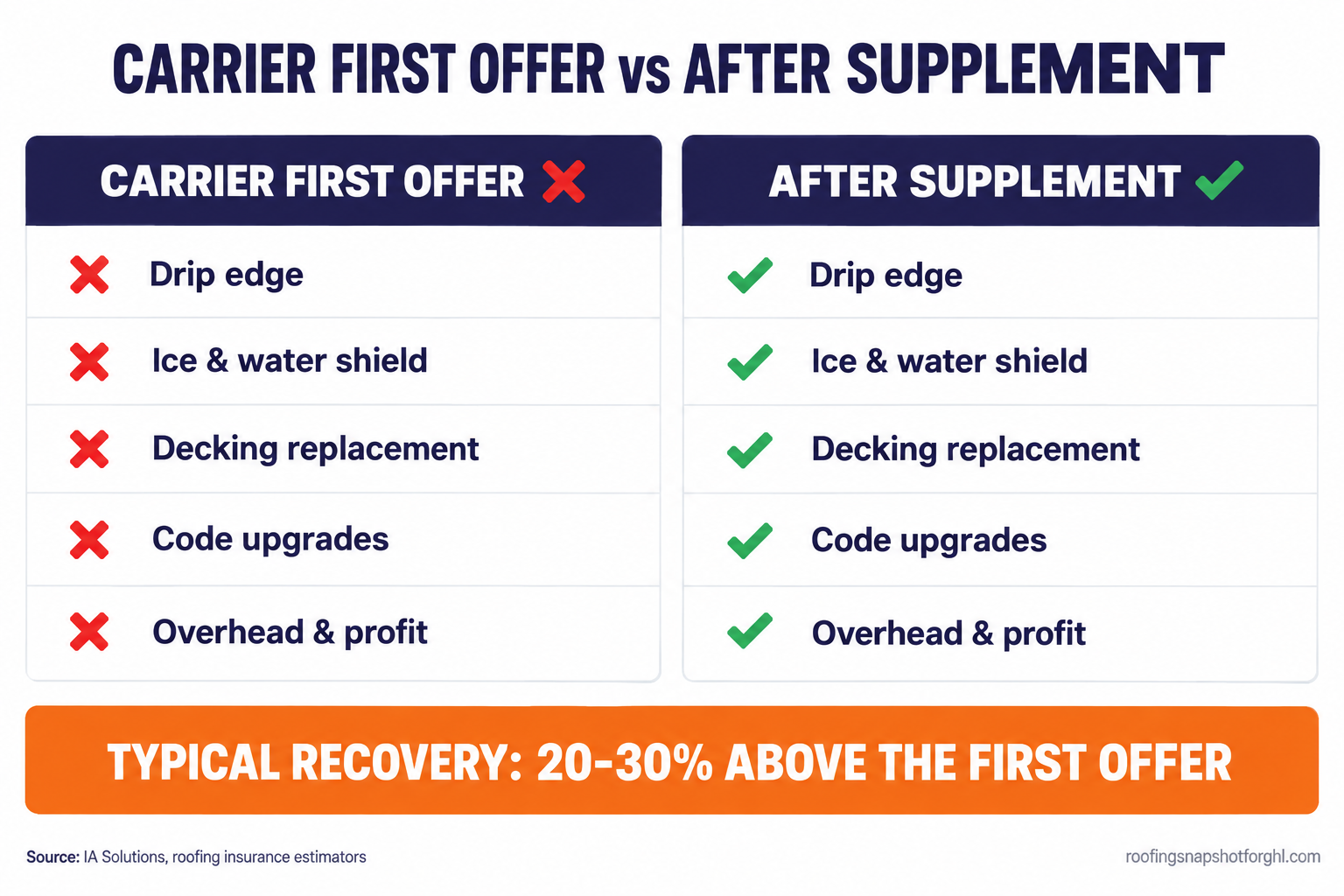
The lines a fast first estimate tends to skip, and what a documented supplement puts back. Typical recovery runs 20 to 30 percent above the first offer (IA Solutions).
Stage 4: Build the evidence packet
Setup. A supplement is approved on evidence, not on your word. For each added or corrected line, attach the proof: the dated photo, the manufacturer spec or code citation for anything code-driven, the measurement report, and a one-line reason. Package it as a single clean PDF ordered to match your estimate.
How it breaks. You send a pile of photos and a separate estimate and ask the adjuster to connect them. They will not. Unmatched evidence is the single most common reason a fair supplement gets ignored. Every photo must be labeled to its line. This is exactly the document assembly a custom claims workflow handles automatically, pulling the tagged photos into a formatted packet the moment the comparison is done.
Stage 5: Submit with the homeowner’s authorization
Setup. Submit the packet through the carrier’s supplement channel with the homeowner’s written authorization on file. That authorization keeps you on the legal side of Stage 2: you are submitting your scope with the policyholder’s consent, not acting as their representative. Confirm the claim number, the adjuster’s name and email, and the carrier’s preferred method before you send. Submit within a week; many carriers apply time limits, so do not let a finished packet sit.
How it breaks. You submit without authorization, and either the carrier refuses to talk to you or you drift into representing the homeowner, which is the unlicensed-adjusting problem from Stage 2. Signed authorization first, every time.
Stage 6: Work the adjuster follow-up cadence
Setup. This is where supplements are won and lost. A submitted supplement does not get denied. It gets forgotten under the next fifty files on the adjuster’s desk. Your job is a steady, documented cadence until you get a written decision, running from a receipt confirmation at day 2 to a supervisor escalation at day 15 (the exact messages are in the steal-this section below). Start the clock the day you submit and log every touch, because dates and a paper trail matter if the file ever goes to appraisal.
How it breaks. You follow up once, get voicemail, and the file goes cold for a month. Manual follow-up loses to a busy week every time. The moment a job hits “supplement submitted,” a CRM can schedule the whole cadence, draft each message, and remind you to make the day-10 call. It is the same discipline that runs your insurance claim follow-up system, pointed at the adjuster instead of the homeowner. Automated texts are still regulated, so keep consent on file and register your messaging under A2P 10DLC; unsolicited automated texts run $500 per message (47 U.S.C. 227).
Stage 7: Track approval to the depreciation check
Setup. Approval is not the finish line. Most storm policies pay in two parts: the actual cash value up front, then the recoverable depreciation once the work is complete and you invoice for it (Insurance Information Institute). A supplement approved but never invoiced for its depreciation is money you earned and never collected. Submit the completion certificate and final invoice as soon as the job passes final inspection, and follow the same cadence until the check clears.
How it breaks. The approval comes in, everyone celebrates, and the recoverable depreciation is never claimed because no one owned the last step. A claims pipeline with a “depreciation released” stage, plus a report that flags any approved file with no final check, closes that leak. It is one of the roofing KPIs worth watching every week.
Illustrative supplement recovery by type. A single missed line item runs a few hundred to a couple thousand dollars; a full code, layers, and O&P supplement can top $18,000. Source: industry estimator ranges via IA Solutions.
Steal this: the supplement follow-up copy
The system is only as good as the messages you send. Here is the copy, verbatim. Swap the brackets and keep the tone professional and scope-focused, never claim-focused.
That block is the difference between a supplement that moves and one that dies, and it is the part every shop skips.
Run it for a solo, a mid-size, and a large shop
The seven stages do not change with your size. Who runs them, and how much you automate, does.
Solo operator. You are the estimator, the follow-up, and the crew lead. Your risk is Stage 6: you cannot chase adjusters while you are on a roof, so supplements go cold. Automate the cadence first, then use a supplement service per file rather than buying Xactimate for a handful of claims a month.
Mid-size, three to five crews. Now the failure mode is handoffs. The crew documents, the office estimates, and nobody owns Stage 7, so approved depreciation goes uncollected. Put every claim on a pipeline with named owners per stage and a hard rule that tear-off cannot start until photos are uploaded. Your office manager runs the cadence out of the CRM. This is the size where a claims track pays for itself in the first storm.
Large shop with a claims coordinator. You have the people, so your leak is visibility. With dozens of open files, supplements slip because no one sees the whole board. You need reporting: files by stage, average days-to-decision by adjuster and carrier, approved files with no final check, and total recovery per rep. At this size a custom claims workflow that assembles packets and surfaces stalled files is usually the highest-ROI software you own.
Solo shops win by automating follow-up, mid-size shops win by fixing handoffs, large shops win by making the pipeline visible. Same system, different pressure point.
Objections
“Isn’t supplementing basically public adjusting?” Not if you stay in your lane. You are pricing and submitting the work in your signed contract with the homeowner’s authorization, and discussing that scope with the adjuster. You are not negotiating the settlement or interpreting the policy, which is the line public adjusters are licensed to cross (NAPIA). Keep every message about the roof and the estimate.
“My adjuster ignores supplements anyway.” They ignore undocumented supplements. A packet with a photo and a reason on every line, priced to the current Xactimate list, is much harder to ignore, and a logged cadence removes the “I never saw it” excuse. When a well-documented, fairly priced supplement is still stonewalled, that is what the appraisal clause is for.
“I already use CompanyCam and EagleView. Isn’t that enough?” Those are excellent adjacent tools, and you should keep them. But a photo app and a measurement report are not a claims pipeline. They capture evidence and measurements; they do not schedule the adjuster follow-up, track a file to the depreciation check, or flag which approved jobs never got their final check. That tracking is the CRM’s job, and it is where the recovered dollars come from.
“Do I have to buy Xactimate?” Not if you are small. It is worth it once you run enough claims a month to justify the subscription; the full cost picture is in our breakdown of what roofing software actually costs in 2026. Below that, a per-file supplement service converts your scope into a matching, current-priced estimate for less than the recovery you would leave behind.
“Won’t chasing supplements slow my crews down?” The crews are not chasing anything. Their only added job is the photo checklist at inspection and tear-off, a few minutes each. The comparison, the packet, and the follow-up happen in the office or the CRM, off the roof.
Frequently asked questions about roofing supplements
What is a roofing insurance supplement?
A supplement is a request to the carrier to add or correct line items the first estimate missed, such as an extra shingle layer, ice-and-water shield, drip edge, decking replacement, code upgrades, or overhead and profit. It is you being paid for real, documented work on a job you are contracted to complete, not a renegotiation of the homeowner's claim.
How much more do supplements typically recover?
Supplements filed with a detailed, photo-backed contractor estimate typically recover 20 to 30 percent above the carrier's first offer, according to roofing insurance estimators. The dollar amount ranges from a few hundred dollars for a single missed line to five figures for a full code, layers, and overhead-and-profit supplement.
Is it legal for a roofing contractor to submit a supplement?
Yes, when done correctly. You may document damage, prepare an estimate, submit it with the homeowner's written authorization, and discuss the scope of your work with the adjuster. You may not negotiate the settlement, interpret the policy, or waive the deductible, which crosses into unlicensed public adjusting and, for deductibles, insurance fraud in states like Florida.
How long do I have to file a supplement?
It varies by carrier and policy, and some apply time limits, so submit as soon as your comparison and evidence packet are ready. Recoverable depreciation is claimed after the work is complete and you submit the completion certificate and final invoice.
Do I need Xactimate to get supplements approved?
Not necessarily. But your estimate needs to be in Xactimate-style line items priced to the current monthly list for the loss ZIP, because that is how adjusters price claims. Larger shops run it in-house; smaller shops use a per-file supplement service.
What is the fastest way to speed up supplement approvals?
Complete documentation with a dated photo tied to every line item, plus a scheduled, logged follow-up cadence with the adjuster instead of one-off attempts. Documentation gets it approved on its merits; the cadence keeps it from being forgotten. A CRM automates both.
The file that no longer sits in the pile
Go back to that finished roof waiting on the light check. Under this system it never sits in a pile. The photos were captured before tear-off, the estimate went out in matching Xactimate lines, the comparison caught every missed item, the packet tied a photo to each one, and the follow-up ran itself until the adjuster gave a written decision. The supplement is not a second job you dread. It is a stage in a pipeline that mostly runs on its own, and it is the difference between the profit you quoted and the profit you keep. You do not have to build that pipeline from scratch.