
It is a Tuesday in April, the radar just lit up over your county, and you are running a roofing company off three browser tabs and a group text: a CRM, a measurement tool, a photo app. Your phone is buzzing with two storm calls you cannot answer because you are up a ladder. You have decided you need one real system, and you have narrowed it to the two names everybody in roofing says out loud: JobNimbus and AccuLynx.
Here is the short answer first. For a shop running one to five crews, JobNimbus is usually the better first “real CRM” because its pricing is easier to reason about and it scales in smaller steps, while AccuLynx is the more complete production suite that earns its higher, per-seat cost once you are bigger. Roofr is the honest wildcard if your revenue leads with measurement and proposals, and Leap is worth a look for financing-heavy remodeling. But all four share one blind spot that costs more than the subscription: none was built to answer a storm call in five seconds and chase a cold lead for you. This post scores the four across eight things that decide the bill, then shows you where the real leak is.
Key Takeaways
- JobNimbus is the easier on-ramp for a small shop: a flat base plus per-user fees, clearer to price, and it owns SumoQuote for proposals (Projul, 2026).
- AccuLynx is the deeper production suite, on a pure per-user model (roughly $55–$85/user/month), so it starts near $299/mo and commonly runs $1,000+/mo for a mid-size crew (Hook Agency, 2025).
- Both hide pricing behind a demo. Roofr is the only one that publishes everything: free Starter, $249/mo Essentials, $349/mo Scale, no per-seat fees (Roofr, 2026).
- Ownership risk is real on AccuLynx: a Delaware court ordered Verisk to proceed with its $2.35B purchase, but Verisk is appealing and it still needs clearance (Axios, 2026).
- The gap none of them closes: speed-to-lead and automated follow-up, the layer most 1-5 crew shops still do by hand.
Table of contents
- What the wrong CRM actually costs you
- The four names, and the 8 things that decide it
- 1. Pricing: published vs demo-gated
- 2. Core production features
- 3. Estimating and proposals
- 4. Speed-to-lead: the criterion everybody skips
- 5. Mobile and the field
- 6. Migration and data portability
- 7. Contracts and lock-in
- 8. Ownership risk: the Verisk question
- The full comparison at a glance
- Three scenarios: solo, mid-size, and large
- The compliance layer nobody demos
- Objections
- FAQ
What the wrong CRM actually costs you
Picking the wrong CRM is not a $200 mistake. It is a season of leaked jobs plus a migration bill to fix it. Two forces make the stakes high in roofing. First, the volume is spiky and huge. NOAA’s Storm Prediction Center logged 5,432 US hail events in 2025, up from 5,373 in 2024 (Insurance Information Institute, 2026), and State Farm alone paid more than $3.5 billion in hail claims in 2022 (State Farm, 2023). When a storm rolls through, your CRM either helps you catch that wave in the first 48 hours or it is a filing cabinet you update after the jobs are gone.
Second, the response window is brutal and most shops miss it. Lead Response Management research found you are far more likely to reach and qualify a lead if you respond within five minutes rather than thirty (Harvard Business Review, 2011). A production CRM logs the lead, but somebody still has to see it and call, and on a storm Tuesday nobody sees it. So the real cost of the wrong tool is the per-seat fee you did not model, the migration you do twice, and the cold leads piling up while you compare feature lists.
The four names, and the 8 things that decide it
Everybody lists JobNimbus and AccuLynx as the two-horse race, because they are the two most-used dedicated roofing production CRMs. An honest comparison for a small shop adds two more. Roofr belongs because it is the only vendor that publishes full pricing and it leads with measurement-to-proposal speed. Leap (formerly JobProgress, now under Nexa Equity) belongs because financing and slick proposals are its whole pitch, which matters if a chunk of your work is retail rather than insurance.
One line to keep you out of a common trap: EagleView, Hover, RoofSnap and CompanyCam are not CRMs. They measure roofs or store job photos. Do not let a rep or a listicle frame them as an AccuLynx or JobNimbus replacement. Compare production CRM against production CRM. The eight criteria below run in the order that moves the decision: pricing, production features, proposals, speed-to-lead, mobile, migration, contracts, and ownership risk.
1. Pricing: published vs demo-gated
This is where the two leaders differ before you open the feature list, and it matters more than any single feature.
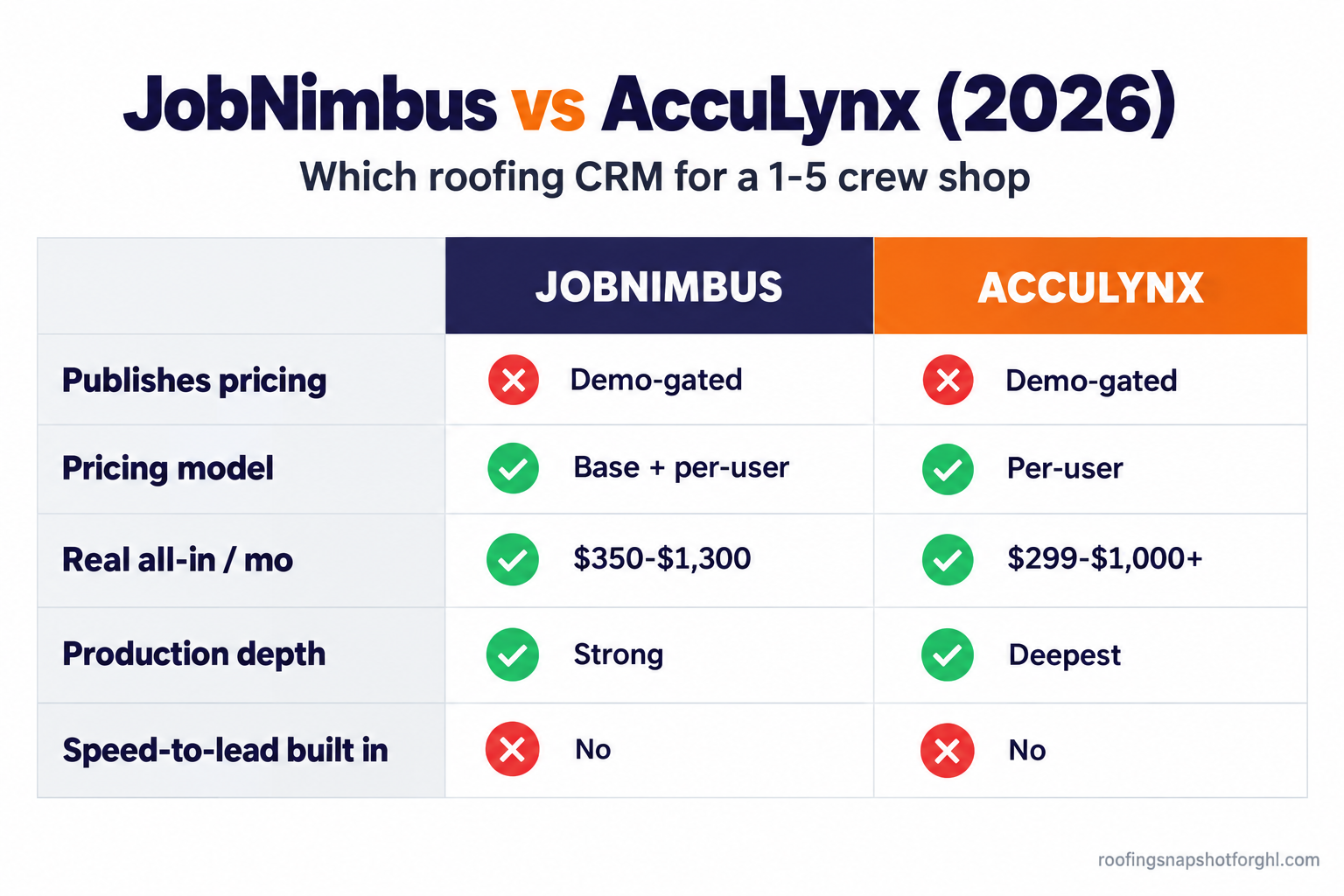
AccuLynx does not publish full pricing. The public entry is an Essential plan around $250/month; everything past that goes through a sales call. Underneath it runs a pure per-user model, reported at roughly $55/user for Essentials up to $85/user for Elite (Hook Agency, 2025). A small team starts near $299/month; a mid-size crew commonly runs $1,000 or more once texting, SmartDocs, the customer portal, and integrations stack on top. One roofer on r/Roofing (August 2025, a single user report) landed at “about 5k per month with all our add-ons.”
JobNimbus is also demo-gated, but gentler at small scale. It is a hybrid: a flat base plus per-user fees. The Growing plan is about $225/month base and Established about $550/month base, with per-user fees of roughly $20 to $75/month by role, and texting from $49 to $249/month (Projul, 2026). Most shops land between $350 and $1,300/month. That flat-base start is why JobNimbus usually feels more affordable to a two or three person office, and why AccuLynx’s per-seat line pulls ahead as you hire.
Roofr is the anchor because it publishes everything: Starter free, Essentials $249/month ($209 annual), Scale $349/month ($299 annual), and no per-seat fees (Roofr, 2026), with measurement reports billed separately. Leap is demo-gated, reported around $79/month Essential and $298/month Team plus roughly $99/user, on a one-year contract (Roofing Software Guide, 2026).
Round 1: JobNimbus for a small shop on clarity and gentler scaling. Roofr wins outright if published, predictable pricing is your priority.
2. Core production features
This is AccuLynx’s home turf. As the most established roofing production CRM, it runs the whole job: lead to estimate, material ordering, labor scheduling, job costing, insurance and supplement tracking, a customer portal, and aerial measurement through integrations. If your day is spent deep inside production and supplements, AccuLynx has the most complete native toolset of the four, and that depth is what its per-seat price is buying.
JobNimbus is close, and for many small shops close enough: contact and job boards, customizable pipelines, estimating, work orders, scheduling, automations, and QuickBooks sync. It is a genuine production CRM, not a lightweight tool. The gap from AccuLynx shows only in the deepest corners of insurance production and job costing. Roofr is a different shape, measurement-to-proposal first with a lighter CRM behind it, superb at getting a homeowner a fast number but not built to run deep supplement production. Leap sits between, with strong proposals and financing aimed at retail remodeling.
Round 2: AccuLynx on raw production depth. JobNimbus for “enough production without the enterprise bill.” Roofr if your revenue leads with the estimate.
3. Estimating and proposals
Every one of these wants to own the moment you hand a homeowner a number, because that moment is where deals are won.
JobNimbus owns SumoQuote, a dedicated proposal tool it acquired and bundles in, well liked for clean option-based proposals (good, better, best) that close retail jobs, a real edge if a chunk of your work is out-of-pocket. AccuLynx answers with SmartDocs and estimating tied tightly to its material and measurement flow, so estimate, order, and job costing live in one place: less flashy proposal, more production accuracy. Roofr is the fastest of the four from an address to a presentable estimate, because instant measurement and the estimator are the product. Leap is proposal-and-financing forward, with digital contracts and lender integrations for the retail close.
Round 3: Roofr for raw speed to a number, JobNimbus for polished proposals, AccuLynx for estimate-to-production accuracy, Leap for financing-heavy retail.
4. Speed-to-lead: the criterion everybody skips
Here is the criterion the vendor demos gloss over, and it decides your storm season. None of these four was built to answer a lead in five seconds and chase it automatically until it converts or dies. They log leads. They do not hunt them.
When a storm call comes in while your team is on roofs, the lead lands in a pipeline stage and sits there until a human opens the CRM, sees it, and calls. On a busy Tuesday that human is you, on a ladder. By the time anyone calls back, the homeowner has already talked to the out-of-state door-knocker who rang their bell an hour ago. The Lead Response Management research is blunt: the odds of qualifying a lead drop off a cliff after the first few minutes. This is the difference between a system of record and a system of action. What a 1-5 crew shop is missing is the layer that instantly texts every new lead within seconds, follows up for days, answers the missed call while you are on the roof, and pushes reviews out after the tear-off. Their texting add-ons ($49–$249/month) are message-sending, not real speed-to-lead automation. Our breakdown of why roofing lead response time decides who signs the roof goes deeper on the math.
Round 4: No native winner. This is the gap all four leave open, and the most expensive one.
5. Mobile and the field
Your office lives in the CRM. Your crews live in the app. If the mobile experience is bad, adoption dies and your data goes stale, which quietly ruins everything else you paid for.
AccuLynx and JobNimbus both ship mature mobile apps that field crews use daily for photos, job updates, and scheduling. JobNimbus’s is frequently praised as straightforward for reps; AccuLynx’s is tied into its full production flow. Both beat running production off a spreadsheet and a text thread. Roofr’s mobile story centers on capturing the job and moving a measurement fast. Leap is strongest at the doorstep: its app is built for the in-home presentation, proposal, and financing signature on a tablet. Mobile quality is worth testing yourself during a trial, because a rep who will not use the app is worse than no app. Put it in a real foreman’s hands for a week before you decide.
Round 5: AccuLynx and JobNimbus roughly even for production crews. Leap wins the in-home retail presentation.
6. Migration and data portability
Nobody demos this and everybody regrets ignoring it. Two questions decide it: how hard is it to get your data in, and how hard is it to get it out if you leave.
Getting in is real work with any of these: moving contacts, job history, photos, documents, and pipeline stages through CSV exports and vendor-assisted onboarding. A typical CRM switch runs a few weeks with cleanup and a stretch of running two systems in parallel, so do not start one in the middle of storm season. Our guide to migrating a roofing business into a modern system walks the steps so you do it once. Getting out is the part vendors are quiet about. Both leaders let you export core data, but a complete export (photos and documents, not just a contact CSV) is often slower than promised, and AccuLynx data is downloadable only while you keep paying. Roofr is generally simpler to leave.
Round 6: Roughly even on getting in. Roofr is easiest to leave; pin the heavier suites down on export terms before you commit.
7. Contracts and lock-in
The subscription is not the only commitment. Contract length and cancellation terms decide how much a wrong choice costs to undo. JobNimbus and AccuLynx typically sell annual arrangements through their sales process, so get the terms in writing during the demo. Leap is the clearest cautionary tale: both plans reportedly require a one-year commitment with a 60-day written cancellation notice, and several reviewers say that meant being billed for months after they asked to leave (Roofing Software Guide, 2026). Roofr, with a free tier and published monthly plans, is the lowest-commitment way to start. The tighter your cash flow and the less sure you are about fit, the more a long contract with a long notice period can hurt, so start with the shortest honest commitment and commit annually only once you know it fits.
Round 7: Roofr for lowest lock-in. Read Leap’s cancellation clause before signing, not after.
8. Ownership risk: the Verisk question
This one is specific to AccuLynx in 2026, and worth understanding before a multi-year deal. Verisk, an insurance-data giant, agreed to buy AccuLynx for $2.35 billion in July 2025, later tried to back out, and in August 2026 the Delaware Court of Chancery ordered it to proceed. Verisk has appealed, and the deal still needs regulatory clearance, so it is not yet final (Axios, 2026; Bloomberg Law, 2026). A roofing CRM owned by a company that also sells claims data to carriers is a genuine change in incentives. This is not a reason to rule AccuLynx out. It is a reason to keep your data portable, avoid long hard-to-cancel contracts until the picture settles, and ask the rep how ownership affects pricing and your information.
Round 8: A wash on quality, but AccuLynx carries a specific ownership question a careful buyer should factor into contract length.
The full comparison at a glance
| Criterion | JobNimbus | AccuLynx | Roofr | Leap |
|---|---|---|---|---|
| Publishes pricing | No (demo) | No (demo) | Yes, in full | No (demo) |
| Model | Base + per-user | Per-user | Flat, no per-seat | Base + per-user |
| Real all-in (small shop) | $350–$1,300 | $299–$1,000+ | $209–$349 | $298+ |
| Production depth | Strong | Deepest | Lighter (estimate-led) | Medium |
| Proposals | SumoQuote (owned) | SmartDocs | Instant estimates | Financing-forward |
| Mobile for crews | Strong | Strong | Capture-focused | In-home sales |
| Contract / lock-in | Annual (confirm) | Annual (confirm) | Free tier, monthly | 1-yr + 60-day notice |
| Speed-to-lead built in | No | No | Partial | No |
Three scenarios: solo, mid-size, and large
The same four tools give three different answers depending on your size.
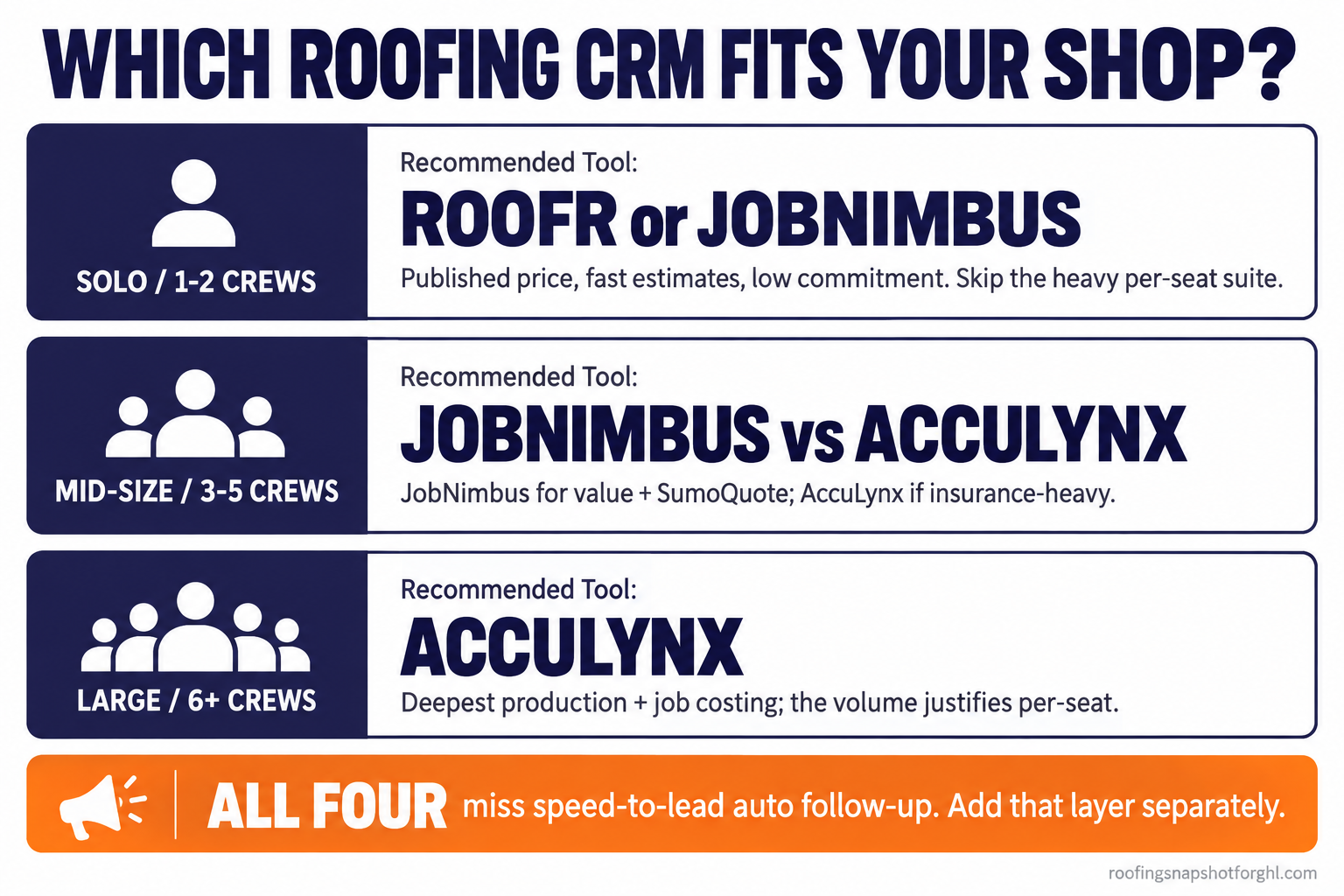
Solo or 1-2 crews (you close, produce, and invoice). Your daily pain is not production depth. It is speed-to-lead and not dropping the ball while you are on a roof. A heavy per-seat suite is more than you need. Start with Roofr (published price, fast estimates, low commitment) or JobNimbus on its Growing base, then put your energy into the follow-up layer, because that is what converts storm calls. AccuLynx at this size is usually a battleship to cross a pond.
Mid-size, 3-5 crews with a small office. This is the real JobNimbus vs AccuLynx decision. If your work is insurance and supplement heavy and your team lives in the CRM all day, AccuLynx’s production depth starts to earn its per-seat cost. If you want strong production with proposals and gentler pricing, JobNimbus with SumoQuote is usually the better value. Either way, model your peak headcount before you sign, and budget separately for speed-to-lead automation.
Large, 6+ crews, multiple offices. Production depth and job costing matter most, and the per-seat math is a bigger line, but you have the volume to justify it. AccuLynx is the natural fit for deep insurance production. Whatever you run, get export terms in writing and keep the lead-capture and follow-up layer separate so a future migration does not cost you your automation too.
The compliance layer nobody demos
Whatever CRM you pick, the moment you start texting leads and door-knock follow-ups you step into rules the demo never mentions, and getting them wrong is expensive.
Texting is governed by TCPA and A2P 10DLC. To send business SMS through any of these platforms’ texting add-ons, your traffic runs over 10DLC, which means registering your brand and campaigns and getting real, documented consent before you text. Skip registration and your messages get filtered or blocked; TCPA violations carry statutory damages per message. That is your job, not the CRM’s, and we cover it in the A2P 10DLC registration guide for roofing contractors. Storm-lead marketing has a second constraint most sites ignore: several states restrict how contractors talk about insurance claims. Laws like Wisconsin’s 2013 Act 24 and Florida’s SB 76 bar contractors from negotiating claims or offering to absorb deductibles, which kills the “we handle your insurance claim for you” copy a lot of shops still run in their follow-up. Our guide to what roofers can and cannot legally say about claims lays out the language to avoid. Pick your CRM for the workflow; build your follow-up copy for the law.
Objections
“I already pay for AccuLynx. Is switching worth it?” Maybe not. If AccuLynx runs your production well and the bill is tolerable, do not rip it out. The higher-leverage move for most shops is adding the speed-to-lead and follow-up layer AccuLynx does not do, so the leads it logs actually get chased. Switch CRMs only when the tool is fighting your workflow or the bill has outrun the value.
“Isn’t JobNimbus just the cheaper AccuLynx?” No. They overlap heavily, but JobNimbus scales differently, owns SumoQuote for proposals, and is slightly lighter in the deepest insurance corners. For a 1-5 crew shop that usually favors JobNimbus on value; for a large insurance-production operation, AccuLynx’s depth is the point.
“Why does Roofr keep coming up if it is not a full production CRM?” Because it is the only one of the four that publishes its full price, and a lot of small shops overbuy. If your bottleneck is getting a homeowner a fast, professional number and you do not need deep supplement production, Roofr solves your actual problem for a fraction of a per-seat suite.
“Do I need to be technical to run this?” Not to run the CRM day to day. The technical part is the setup, migration, and wiring the follow-up automation, which is the work most operators do not have time for during storm season. That is the case for a done-for-you install: someone else configures the pipeline and automations, and you run the business.
The bottom line
Back to that Tuesday in April with the radar lit up. The tool you pick is not what wins the storm. JobNimbus is the smarter first real CRM for most 1-5 crew shops, AccuLynx is the deeper suite that pays off once you are bigger and insurance-heavy, Roofr is the transparent low-commitment choice if you lead with the estimate, and Leap is the retail-financing specialist. Pick the one that fits the job you do every day, get the export terms in writing, and do not sign a long contract you cannot leave. Then fix the part none of them fixes: put a layer on top that texts every storm lead back in seconds, follows up for days without you, catches the missed call while you are on the roof, and asks for the review after the tear-off.
JobNimbus vs AccuLynx: which is better for a small roofing company?
For most 1-to-5-crew shops, JobNimbus is the better first real CRM: its flat-base-plus-per-user pricing is easier to reason about, it scales in smaller steps, and it includes SumoQuote for proposals (Projul, 2026). AccuLynx is the deeper production suite that earns its higher per-user cost once you are bigger and insurance-heavy. Neither handles speed-to-lead automation natively.
How much does AccuLynx cost vs JobNimbus in 2026?
Both gate pricing behind a demo. AccuLynx runs a per-user model reported at roughly $55–$85/user/month, so a small team starts near $299/mo and a mid-size crew commonly pays $1,000+/mo with add-ons (Hook Agency, 2025). JobNimbus uses a flat base (about $225–$550/mo) plus per-user fees and texting ($49–$249/mo), landing most shops between $350 and $1,300/mo (Projul, 2026).
Is Roofr a real alternative to AccuLynx and JobNimbus?
For some shops, yes. Roofr is the only one that publishes full pricing (free Starter, $249/mo Essentials, $349/mo Scale, no per-seat fees) and it leads with instant measurement and proposals (Roofr, 2026). It is lighter on deep insurance-supplement production than AccuLynx, so it fits shops whose revenue leads with the estimate rather than the supplement.
Does the Verisk acquisition change whether I should buy AccuLynx?
It is worth factoring in. A Delaware court ordered Verisk to proceed with its $2.35 billion purchase of AccuLynx, but Verisk is appealing and the deal still needs regulatory clearance, so it is not final (Axios, 2026). A roofing CRM owned by an insurance-data company is a change in incentives, so keep your data portable and avoid long, hard-to-cancel contracts until it settles.
Do JobNimbus or AccuLynx handle speed-to-lead follow-up automatically?
Not on their own. Both are systems of record: they log a lead into a pipeline stage and wait for a human to call. Their texting add-ons send messages but are not true speed-to-lead automation. Since lead odds fall off a cliff after the first few minutes (Harvard Business Review, 2011), most 1-5 crew shops add a separate layer that instantly texts new leads and follows up for days.
Can I move my data out of AccuLynx or JobNimbus if I switch?
Both let you export core data, but a complete export (photos and documents, not just a contact CSV) is often slower than promised, and AccuLynx data is downloadable only while you keep paying. Before you sign any roofing CRM, ask exactly how you export your full data, in what format, and confirm you own it. If the rep is vague, treat that as the answer.